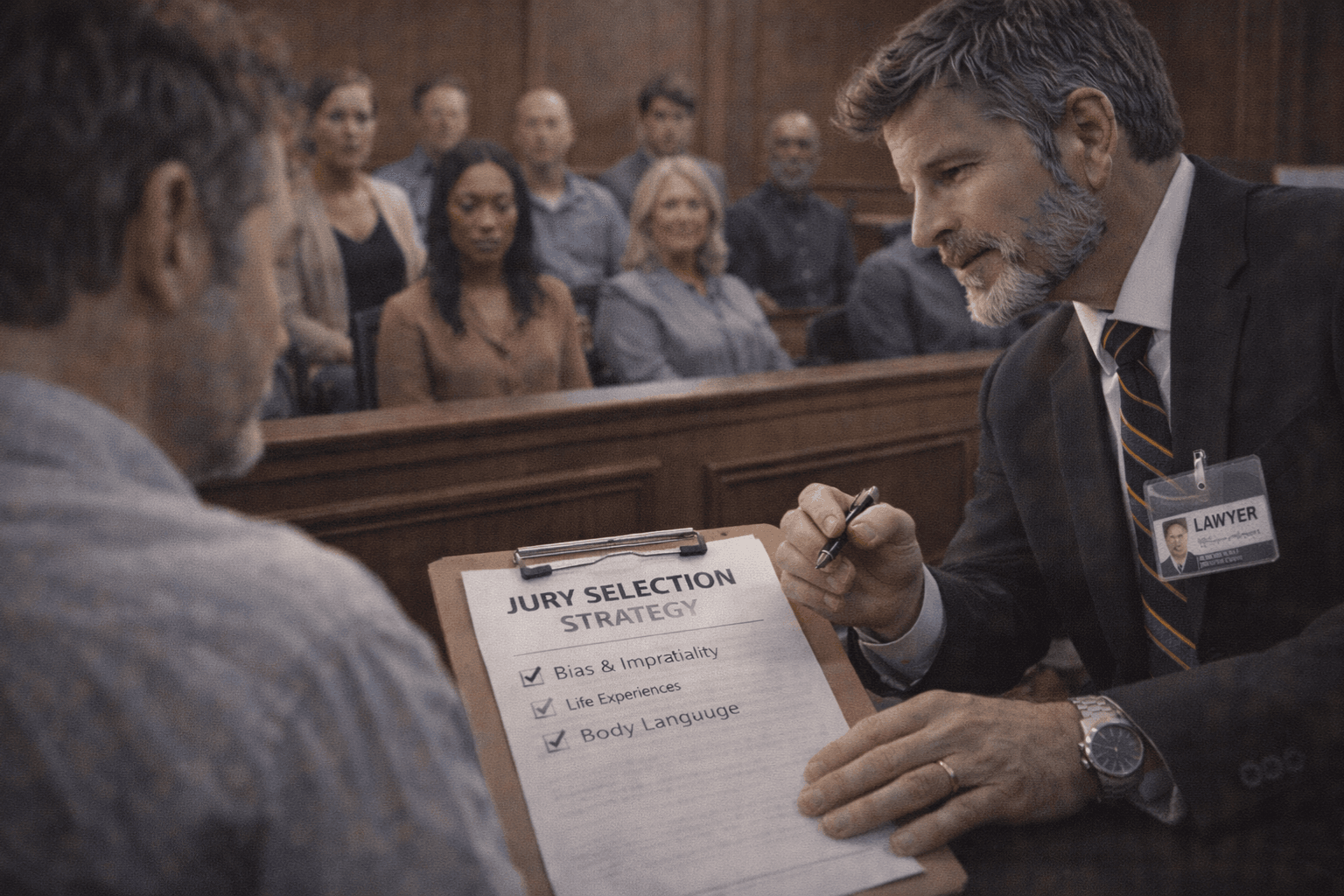
Voir Dire: Jury Selection Strategy for Personal Injury Trials
voir dire jury selection strategy
Voir dire strategy in personal injury trials focuses on identifying juror bias, building a clear record for cause challenges, and preserving appellate rights. The framework assumes careful legal advice and deliberate hiring a lawyer decisions when trial is likely. A complete record aligns civil litigation timelines with the statute of limitations, the discovery process under evidence rules, and qualified expert witnesses. It should also document a clear contingency fee agreement, a defensible demand letter, disciplined settlement negotiation, and realistic trial preparation, with mediation or arbitration when appropriate. For broader trial framing, see Trial advocacy guide. The analysis below stays focused on jury selection standards and record preservation.
This overview explains how voir dire jury selection strategy considerations shape evidence, liability, and recovery planning.
This guide focuses on identifying juror bias, building a record for cause challenges, and the limitations on "rehabilitation" questioning. We examine peremptory strike strategy, the Batson framework for discriminatory strikes, and the use of anchoring techniques in damages-focused voir dire.
Voir dire strategy depends on the court's method, time limits, and local rules. A clear plan aligns case themes with juror screening and preserves rulings for post-trial review.
Definitions
Definitions used throughout this guide:
- Voir dire: the jury selection process.
- Cause challenge: request to excuse a juror for bias or disqualification.
- Peremptory challenge: strike without stated cause within limits.
- Panel: the pool of potential jurors.
- Juror bias: predisposition that affects impartiality.
Key terms in practice: cause challenges rely on bias or disqualification shown by juror statements, while peremptory strikes are discretionary but limited and monitored for discrimination concerns. Rehabilitation refers to follow-up questioning that attempts to cure bias, and errors in striking for cause must be preserved through objections on the record. Questionnaires are written responses that can reveal bias early and should be filed to preserve the record.
Legal Framework
Voir dire is governed by state court rules and local procedures, with constitutional limits on discrimination in jury selection. Federal courts apply Federal Rule of Civil Procedure 47 and local rules. For federal procedural guidance, review U.S. Courts Rules and Policies.
Core Authorities
Courts control voir dire scope, time limits, and questions. Counsel must preserve objections to biased jurors and adverse rulings. The record should capture each challenge, ruling, and the basis for exclusion.
Cause Challenges and Bias
Cause challenges require a showing of bias, disqualification, or inability to follow the law. The record should include the juror's statements, counsel's motion, and the court's ruling.
Peremptory Challenges and Strikes
Peremptory challenges are limited in number and must comply with anti-discrimination rules. The record should document the use and sequence of strikes to address later challenges.
Standard of Review
Appellate review evaluates voir dire rulings for abuse of discretion and prejudicial error. The record must show preserved objections and the impact of the ruling on the final panel.
Liability Analysis - Voir Dire: Jury Selection Strategy for Personal Injury Trials
Voir dire in personal injury trials should surface attitudes about fault, personal responsibility, and damages. The record should connect bias indicators to the case themes.
Liability anchors:
- Attitudes toward lawsuits and compensation.
- Beliefs about personal responsibility and risk.
- Opinions on medical treatment and pain claims.
- Views on insurance and claim legitimacy.
Liability matrix in narrative form: fault allocation bias can be revealed through blame tendencies and should trigger targeted follow-up for cause challenges. Credibility skepticism toward plaintiffs can surface in admissions and should be documented for panel selection and strike decisions. Negative views of medical treatment create damages proof risk and require clarifying questions. Anti-insurance sentiments can skew verdict range expectations and should be noted for strike allocation.
Evidence Handling - Voir Dire: Jury Selection Strategy for Personal Injury Trials
Evidence handling in voir dire focuses on the record of juror statements, objections, and rulings. The transcript is the core record for appellate review.
Counsel should ensure sidebar discussions are summarized on the record. A clear record of off-the-record discussions protects preservation and reduces appellate ambiguity.
Juror demographics and hardship responses should be documented when relevant to cause challenges. The record should reflect the basis for hardship excusals and any objections.
Key evidence controls:
- Preserve the full voir dire transcript.
- Record all cause challenges and rulings.
- Document peremptory strikes and sequence.
- Preserve juror questionnaires when used.
Evidence control considerations: transcripts can be incomplete without verification of the court reporter, questionnaires can be lost if not filed with the clerk, strike lists should be maintained to show sequence and rationale, objections must be on the record, and rulings should be clarified when the basis is unclear.
Insurance Structure - Voir Dire: Jury Selection Strategy for Personal Injury Trials
Insurance references in voir dire are limited by court rules and evidentiary constraints. The record should show compliance with rulings and the scope of permitted inquiry.
Insurance bias questions should be framed to comply with court limitations while still identifying bias. A written outline of permitted questions supports consistency and compliance.
Insurance structure factors:
- Court rules on insurance discussion.
- Limits on mentioning coverage or limits.
- Impact of insurance bias on juror selection.
- Curative instructions when insurance is raised.
For federal civil litigation context, review U.S. Department of Justice Civil Division.
Damages Valuation - Voir Dire: Jury Selection Strategy for Personal Injury Trials
Damages-focused voir dire should assess attitudes toward pain, future care, and non-economic loss. The record should capture juror views that indicate bias against damages categories.
Damages questioning should test willingness to follow the law on non-economic awards. The record should include any juror statements that reveal inability to award such damages.
Damages questioning should also explore views on future care and life-care plans. The record should capture juror willingness to consider long-term costs supported by expert testimony.
Damages categories:
- Medical expenses and future care.
- Lost wages and earning capacity.
- Pain, suffering, and life impact.
- Household services and out-of-pocket costs.
Damages bias indicators in narrative form: skepticism of treatment requires follow-up on necessity and duration, opposition to future care projections can affect strike decisions, negative views of pain claims can signal inability to award non-economic damages, and doubt about employment loss can undermine wage record acceptance.
Procedure Timeline - Voir Dire: Jury Selection Strategy for Personal Injury Trials
Voir dire timing affects trial strategy. The record should include deadlines for questionnaires, pretrial submissions, and motions.
The timeline should track court-imposed time limits and voir dire order. A record of those limits supports later review of restrictions and preserves objections.
Timeline risk points include late questionnaire submissions, restricted questioning without on-record objections, unclear cause challenge rulings, and errors in panel seating. A clear record of each milestone supports preservation.
Pretrial disclosures and voir dire plan. Questionnaire submission and court approval. Voir dire session and challenges. Panel selection and seating. Trial and post-trial motions.
Timeline controls should track the scheduling order, questionnaire deadlines, the panel examination, strike procedures, and confirmation of the sworn panel. Missing these steps creates waiver risk and preservation failures.
Decision Tree - Voir Dire: Jury Selection Strategy for Personal Injury Trials
Decision tree for voir dire strategy:
- Panel seated
- Is bias admitted?
- Yes -> move to strike for cause.
- No -> follow up for clarification.
- Are cause challenges denied?
- Yes -> preserve objection and use peremptory strike.
- No -> preserve ruling and proceed.
- Are time limits strict?
- Yes -> prioritize key bias topics.
- No -> expand to damages and causation themes.
Decision criteria for strike allocation:
- Strength of bias admissions on record.
- Impact of juror on damages and causation themes.
- Availability of peremptory strikes and alternates.
- Court limits on rehabilitation questioning.
Damages Bias Map - Voir Dire: Jury Selection Strategy for Personal Injury Trials
Damages bias mapping helps prioritize jurors for follow-up. A map aligns juror statements with damages categories and risk areas.
In practice, pain skepticism, future care doubt, wage loss skepticism, and fixed views on non-economic limits should be noted by juror and tied to follow-up questions and strike priorities.
Juror Questionnaire Strategy - Voir Dire: Jury Selection Strategy for Personal Injury Trials
Questionnaires provide early insight into bias and experience. The record should preserve questionnaires and any court rulings on disputed questions.
Questionnaire review should flag jurors with strong views on lawsuits, insurance, or medical care. A flagged list supports targeted questioning and efficient strike decisions.
Questionnaire answers should be cross-checked against oral responses for consistency. Any contradictions should be noted on the record and used for follow-up. A contradiction log supports cause challenges and preserves impeachment grounds.
Evidence Handling for Court Rules - Voir Dire: Jury Selection Strategy for Personal Injury Trials
Court rules and local orders govern voir dire scope. The record should include rulings on contested questions and any limitations imposed by the court.
Insurance Structure and Liens - Voir Dire: Jury Selection Strategy for Personal Injury Trials
Liens and insurance issues shape juror attitudes. Counsel should address permissible insurance bias topics within court rules and preserve any rulings on insurance references.
Damages Valuation Methods - Voir Dire: Jury Selection Strategy for Personal Injury Trials
Damages valuation methods should be previewed in voir dire through juror attitudes toward evidence and expert testimony. The record should show each juror's willingness to follow law and instructions.
Valuation questioning should connect damages categories to the law and the evidence burden. The record should capture juror agreement to evaluate damages based on evidence, not personal preferences.
Settlement Evaluation Framework - Voir Dire: Jury Selection Strategy for Personal Injury Trials
Settlement evaluation should incorporate voir dire risk, especially when juror bias indicates high variance. A structured framework links jury risk to settlement posture.
Assess bias indicators from voir dire responses. Map bias to liability and damages risk. Adjust settlement range for jury variance. Compare adjusted range to policy limits and costs. Decide on trial posture based on record strength.
Settlement range variables: liability risk ranges from disputed fault to strong admissions, damages risk moves from high skepticism to favorable panel attitudes, bias indicators vary by number and intensity of adverse views, and time to trial shifts leverage as trial approaches.
Procedure Timeline Controls - Voir Dire: Jury Selection Strategy for Personal Injury Trials
Timeline controls should track voir dire deadlines, questionnaire submissions, and strike procedures. A timeline chart with docket entries supports compliance.
Timeline controls should track deadlines for submitting proposed questions and objections to panel composition. Those deadlines often determine the scope of voir dire.
Trial Readiness Review - Voir Dire: Jury Selection Strategy for Personal Injury Trials
Trial readiness for jury selection requires a voir dire plan aligned with case themes and instructions. A clear plan supports efficient questioning and record preservation.
Trial readiness checks:
- Voir dire outline aligned with liability and damages themes.
- Strike plan with priority tiers.
- Objection script prepared for cause challenges.
- Transcript access confirmed with court reporter.
Trial readiness risk points: disorganized questioning can lose key admissions, a weak strike plan can leave bias on the panel, missing objection language can undermine preservation, and limited reporter access can create an incomplete record.
Recovery Planning - Voir Dire: Jury Selection Strategy for Personal Injury Trials
Recovery planning should align with the expected verdict range, lien obligations, and net recovery timing. The record should include a distribution plan that accounts for fees, liens, and payment timing.
Recovery planning details: lien payoff planning relies on lien notices and reductions, settlement distribution depends on a final statement, future care funds should match a care plan, and a cost summary supports a realistic net estimate.
Practical Guidance for Claimants - Voir Dire: Jury Selection Strategy for Personal Injury Trials
For related JusticeFinder resources:
- Discovery tools and evidence control
- Settle or go to trial decision guide
- Punitive damages proof standard
For more information, see our guide on Trial advocacy: Opening and closing arguments.
Secondary keyword coverage within this guide includes voir dire preparation, jury questionnaire, cause challenge, peremptory strike, juror bias, panel selection, rehabilitation questioning, strike list, appellate preservation, damages skepticism, fault allocation, insurance bias, non-economic damages, and trial readiness. These concepts are addressed in context rather than as checklists.
FAQ - Voir Dire: Jury Selection Strategy for Personal Injury Trials
What is the purpose of voir dire? Voir dire identifies bias and selects a fair jury panel.
What is a cause challenge?
Summary
Authority guide to Voir Dire: Jury Selection Strategy under U.S. law, focused on cause challenges, bias, and juror rehabilitation. Read our comprehensive and...
Quick Legal Answer: What this guide covers
Authority guide to Voir Dire: Jury Selection Strategy under U.S. law, focused on cause challenges, bias, and juror rehabilitation. Read our comprehensive and...
Quick Legal Answer: Core legal focus
This guide focuses on voir dire jury selection strategy within legal process and the evidence, timelines, and standards typically evaluated under U.S. law.
Quick Legal Answer: When to verify with counsel
Because statutes and rules vary by state, confirm the specifics for your jurisdiction with a qualified attorney or official government resources.
Key Takeaways
- Understand the core rules and evidence standards tied to voir dire jury selection strategy.
- Track deadlines and procedural steps that shape recovery options.
- Document medical records, liability proof, and insurance communications early.
- Compare settlement posture with litigation risk based on the case record.
The Batson Challenge: Eliminating Discriminatory Strikes
Internalizing the Batson Challenge framework is a critical trial strategy for ensuring a fair and diverse jury. Under the U.S. Supreme Court's ruling in Batson v. Kentucky (extended to civil cases in Edmonson v. Leesville Concrete Co.), a party cannot use peremptory strikes to exclude jurors solely based on race, ethnicity, or sex.
The 3-Step Batson Process:
The Prima Facie Case: The objecting party must show that a peremptory strike was used against a member of a protected group and that the circumstances raise an inference of discrimination. The Race-Neutral Explanation: The party who made the strike must then provide a "race-neutral" reason for the strike. This reason does not have to be persuasive, just not discriminatory on its face. (e.g., "The juror appeared uninterested," or "The juror has a background in engineering that I dislike.") The Pretext Phase: The judge then decides if the provided reason is a "pretext" for actual discrimination. This is where most Batson challenges are won or lost.
Trial Tip: If you believe the defense is striking all female jurors in a birth injury case, you must raise the Batson objection at the time of the strike to preserve the record for appeal.
Implicit Bias and the "Social Desirability" Trap
Most jurors will not openly admit to being biased. Instead, they fall into the "Social Desirability Trap," where they give the answer they think the judge wants to hear (e.g., "Yes, your honor, I can be fair").
Identifying "Hidden" Bias:
To uncover implicit bias, trial lawyers use open-ended questions that allow jurors to express their worldview:
- The "Low Cap" Question: "Some people believe that even if someone is proven at fault, there should be a limit on how much money they have to pay, regardless of the injury. How do you feel about that?"
- The "Burden of Proof" Question: "In a civil case, we only have to show that it is 'more likely than not' that the defendant was negligent. For some people, that doesn't feel like enough—they want 'Beyond a Reasonable Doubt.' Does that resonate with anyone on the panel?"
- The "Medical Authority" Question: "If a doctor testifies to something that contradicts your common sense, which one would you rely on more?"
Juror Rehabilitation: Saving Your "Best" Jurors
When a favorable juror (e.g., someone with a background that suggests they understand pain or corporate negligence) makes a statement that sounds biased towards the plaintiff, the defense will move to "Strike for Cause."
The Rehabilitation Checklist:
Before the judge grants the strike, you have the right to "rehabilitate" the juror by asking:
- "Mr. Smith, every person has life experiences. When you said you 'might' have a hard time, were you saying you can't follow the law? Or just that you would be extra careful in evaluating the evidence?"
- "If the judge instructs you that you must put aside your personal opinions and decide only on the evidence presented in this room, can you promise to do that?"
- "Do you understand that 'fairness' doesn't mean starting at zero for both sides—it means starting with an open mind to the facts?"
The "Anchoring" Strategy: Setting Damages Expectations
One of the most controversial but effective voir dire strategies is Anchoring (also known as "Pre-Conditioning"). This involves introducing a large number to the jury early to gauge their reaction.
How to Anchor Safely:
You cannot ask a juror "Would you give $5 million?", as this is often considered an improper "pre-commitment" question. Instead, you frame it as a question of "Scale":
- "In this case, we will be asking for a verdict that is substantial. For some people, anything over $1,000,000 feels like 'too much' regardless of the injury. How do you feel about that?"
- "If the evidence shows that the medical bills alone are $500,000, is there anyone here who would have a 'ceiling' or a limit on how much they could award for pain and suffering?"
The Goal: You are not looking for a promise to award a specific amount; you are looking for "Low-Cap" jurors who have a philosophical bias against high verdicts so you can move to strike them for cause.
Preserving the Record: What to do when the Court limits questioning
Many judges impose strict Time Limits on voir dire (e.g., "You have 20 minutes for the entire panel"). If you are cut off before you can ask about bias, you must "Preserve the Record" for a potential appeal.
The Preservation Protocol:
The Sidebar Objection: Request a sidebar and state: "Your honor, I have 10 more critical questions regarding insurance bias and damages caps that I have not been able to ask. I object to being limited." The "Offer of Proof": If the judge denies more time, you must submit your list of unasked questions to the court reporter to be filed. The "Exhaustion" Rule: In many states, to appeal a voir dire ruling, you must use all of your peremptory strikes and then state on the record: "If I had more strikes, I would have used one on Juror #5, but I am forced to accept them."
Source Box (Official .gov & .edu References)
- U.S. Courts (Jury Selection): Overview of the federal jury selection process and Rule 47. View Site
- American Bar Association (Voir Dire Principles): Best practices for fair and effective jury selection. View Site
- National Center for State Courts (NCSC): Research on implicit bias and jury panel diversity. View Site
- Cornell Law School (LII): Legal breakdown of the Batson Challenge and its progeny. View Site
- Harvard Project Implicit: Scientific research on implicit bias and its impact on decision-making. View Site
Final Checklist - Voir Dire & Jury Selection
- [ ] Batson Audit: Are you tracking the race/gender of every strike (both yours and the opponents) to build a record for a Batson challenge?
- [ ] Rehabilitation Script: Do you have a "rehab" question ready for every juror who admits to a minor leaning?
- [ ] Questionnaire Cross-Ex: Have you flagged contradictions between the juror's written questionnaire and their oral answers?
- [ ] Socio-Economic Mapping: Have you researched the "Jury Pool" demographics for the specific venue (e.g., Rural vs. Urban) to adjust your theme?
- [ ] Alternates Strategy: ensure you have screened the 1st and 2nd alternate jurors with the same intensity as the main panel—one sick juror can change the entire dynamic.
Related Resources
For broader context, review the Legal Process hub.
Related Guides
- Birth Injury Lawyer: Cerebral Palsy & Medical Malpractice Guide
- Can I Sue After Workers Compensation? Third-Party Liability Explained
- Catastrophic Injury Settlements: Life Care Plans & Million-Dollar Claims
Pillar guide: Contingency Fee Agreements: 33-40% Standard & Hidden Costs
Helpful Tool
Use the Attorney Communication Log Google Sheets to organize documentation, expenses, and insurance claim records while applying this guide.
More Legal Process Guides

Structured Settlements vs. Lump Sum: Tax Advantages & Financial Planning
Authority guide to Structured Settlements vs. Lump Sum under U.S. law, focused on tax-free exclusions, personal injury payouts, and IRC Section 104. Read our...

Punitive Damages: Clear & Convincing Evidence Standard
Authority guide to Punitive Damages: Clear & Convincing Evidence Standard under U.S. law, focused on proof, review, and verdict protection. Read our comprehe...

Pedestrian Accident Lawyer: Crosswalk Laws & Injury Claims
Pedestrian Accident Lawyer guide to U.S. crosswalk rules, liability proof, evidence control, insurance structure, and damages valuation. Read our comprehensi...

Motorcycle Injury Lawyer: The Ultimate Hiring Guide (USA)
The ultimate national guide to hiring a motorcycle injury lawyer. Evaluate investigation capacity, trial readiness, and expert networks for any US motorcycle...

Is Lane Splitting Legal? State-by-State Motorcycle Liability Guide
State-by-state verification guide to lane splitting, lane filtering, and lane sharing rules, plus how those rules affect motorcycle accident liability and in...

How to Hire a Motorcycle Injury Lawyer in Las Vegas: Tourist & Local Guide
Hiring a Las Vegas motorcycle injury lawyer. Nevada laws for tourists and locals, comparative fault, and navigating the Vegas court system. Read our comprehe...
Related Documentation Tools
View all toolsThese free spreadsheets help organize evidence, deadlines, and claim documentation for this topic.
Personal Injury Statute of Limitations Tracker Google Sheets
Keep legal timing visible so filing and response windows are not missed with Claim Overview and State SOL Reference before you share records with an insurer or attorney.
Personal Injury Expense and Damages Tracker Google Sheets
Track income disruption with records adjusters and attorneys can review quickly with Claim Overview and Economic Damages before you share records with an insurer or attorney.
Personal Injury Case Preparation Checklist Google Sheets
Build a timestamped evidence file that keeps facts consistent with Case Overview and Case Checklist before you share records with an insurer or attorney.
Settlement Demand Letter Organizer Google Sheets
Estimate negotiable case value and keep damages evidence aligned with Claim Overview and Economic Damages before you share records with an insurer or attorney.