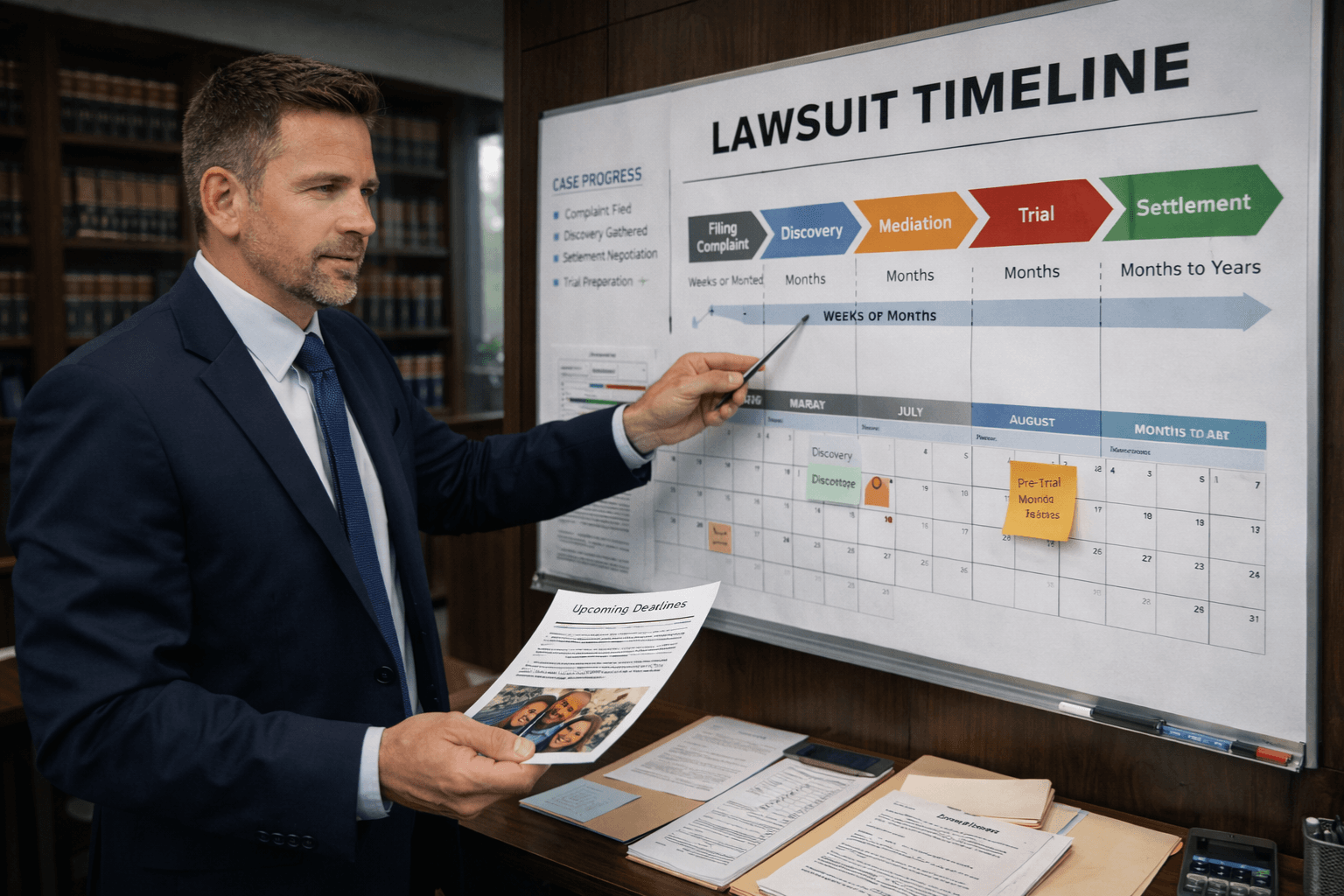
Summary
A step-by-step timeline of truck accident lawsuits, including FMCSA evidence preservation, discovery phases, and settlement checkpoints. Read our comprehensi...
Quick Legal Answer: What this guide covers
A step-by-step timeline of truck accident lawsuits, including FMCSA evidence preservation, discovery phases, and settlement checkpoints. Read our comprehensi...
Quick Legal Answer: Core legal focus
This guide focuses on truck accident lawsuit timeline within truck accident guides and the evidence, timelines, and standards typically evaluated under U.S. law.
Quick Legal Answer: When to verify with counsel
Because statutes and rules vary by state, confirm the specifics for your jurisdiction with a qualified attorney or official government resources.
Key Takeaways
- Understand the core rules and evidence standards tied to truck accident lawsuit timeline.
- Track deadlines and procedural steps that shape recovery options.
- Document medical records, liability proof, and insurance communications early.
- Compare settlement posture with litigation risk based on the case record.
Truck Accident Lawsuit Timeline
Truck accident lawsuits follow a structured timeline, but they often take longer than typical auto cases due to multiple defendants, FMCSA compliance issues, and specialized evidence. This guide maps the discovery process alongside FMCSA evidence and core litigation milestones. A complete record must document FMCSA violations tied to commercial truck liability and trucking company negligence, supported by black box data, ELD logs, and hours of service violations. It should also track cargo securement failure, preserve the driver qualification file, estimate the truck accident settlement range, and confirm commercial insurance layers with early evidence preservation.
Truck accident claims are governed by a mix of state negligence law and federal safety rules. The timeline matters because many critical records are held by a commercial carrier, and those records can be overwritten or discarded quickly. A clear sequence of preservation, investigation, filing, and discovery helps protect a personal injury claim, supports a truck accident lawsuit, and aligns the facts with FMCSA duties.
This overview explains how truck accident lawsuit timeline considerations shape evidence, liability, and recovery planning.
Use this guide as an educational roadmap, not a rigid schedule. Each step builds the record needed to support a personal injury claim, show commercial truck liability, and document the damages caused by the crash. The earlier the timeline is organized, the easier it is to prove causation and to counter defenses that blame the victim or shift fault to other parties.
The timeline below is a planning tool. Actual timelines vary by jurisdiction, court schedules, and case complexity. The most critical factor early in the process is evidence preservation, particularly for electronic data and carrier records.
Truck Accident Lawsuit Timeline: Definitions and Core Concepts
Truck Accident Lawsuit Timeline Definition Notes
The Term refers to complaint. Practical Meaning: Lawsuit filing. Why It Matters: Starts the case. The Term refers to discovery. Practical Meaning: Evidence exchange phase. Why It Matters: Determines liability strength. The Term refers to deposition. Practical Meaning: Sworn testimony. Why It Matters: Builds evidentiary record. The Term refers to fMCSA compliance. Practical Meaning: Federal safety duties. Why It Matters: Liability anchor. The Term refers to mediation. Practical Meaning: Structured settlement process. Why It Matters: Common resolution stage.
These core terms shape how the lawsuit unfolds. A complaint activates court deadlines, discovery controls how evidence is gathered, and depositions lock in testimony. FMCSA compliance supplies a regulatory baseline, while mediation often becomes the first realistic settlement checkpoint.
Truck Accident Lawsuit Timeline: Key Legal Entities
Truck litigation typically involves the commercial truck driver, the trucking company, and sometimes brokers, shippers, or maintenance vendors. Federal Motor Carrier Safety Administration (FMCSA) rules, carrier safety policies, and state tort standards all intersect to define duty and breach.
Truck Accident Lawsuit Timeline: Carrier Safety Duties
Carrier duties often include driver qualification, hours of service monitoring, vehicle maintenance, drug and alcohol testing, and cargo securement. When those duties are breached, the timeline focuses on proving when and how the violations occurred.
Truck Accident Lawsuit Timeline: When to Contact a Lawyer
Early legal guidance helps preserve records, identify all defendants, and avoid missed deadlines. It also helps coordinate medical documentation so damages are linked to the crash.
Step-by-Step Truck Lawsuit Timeline
Phase 1: Immediate Preservation (Days 0-30)
This phase focuses on stopping evidence loss. Electronic data can be overwritten and paper records can be discarded under routine retention schedules. A prompt spoliation letter can put the carrier on notice and preserve the records needed to prove truck driver negligence, trucking company liability, and insurance responsibility.
- Send spoliation letters
- Preserve ELD and ECM data
- Obtain crash report and witness statements
- Document scene evidence and photographs
In these first days, the priority is capturing time-sensitive evidence. Scene photos, witness statements, and police observations can be lost quickly, and electronic records may be overwritten as trucks return to service. Preservation steps should be coordinated with medical treatment so injuries are linked to the collision from the start.
Phase 2: Pre-Suit Investigation (Weeks 2-12)
The investigation phase identifies all responsible parties and clarifies how the crash occurred. This is where a legal team analyzes hours of service violations, maintenance issues, cargo securement failures, and training gaps to build a theory of liability.
- Request carrier records (DQ file, maintenance logs)
- Identify all potential defendants
- Begin medical and damages documentation
This phase often includes expert consultations such as accident reconstruction, human factors review, or trucking safety analysis. The investigation also looks for additional defendants, such as a maintenance company that missed a critical repair or a shipper that failed to secure cargo.
Phase 3: Filing the Complaint (Months 2-6)
Filing the complaint starts the formal lawsuit and freezes the core claims. The allegations should align with the evidence preserved and the regulatory duties that were breached. This stage often includes early negotiations with insurers but remains focused on building a strong pleading.
- Draft and file the complaint
- Serve defendants
- Receive answers and defenses
Defendants often respond with defenses like comparative negligence, sudden emergency, or mechanical failure beyond their control. The complaint should anticipate these defenses by citing relevant FMCSA duties and the evidence preserved in the early timeline.
Phase 4: Discovery (Months 4-18)
Discovery is where the truck accident lawsuit timeline slows and deepens. Parties exchange documents, take depositions, and retain experts. FMCSA-related data such as ELD logs, black box data, and maintenance records often define the strongest liability arguments.
- Exchange documents and records
- Conduct depositions
- Analyze expert reports
- Address discovery disputes
Discovery can include protective orders, motions to compel, and disputes over the scope of production. Many cases turn on whether the carrier promptly produced ELD data, maintenance history, and safety audits that reveal systemic compliance problems.
Phase 5: Mediation or Settlement Conferences (Months 8-20)
Mediation evaluates both liability and damages in a structured setting. When expert findings and FMCSA violations are clear, trucking companies and insurers may see greater exposure and negotiate a higher settlement range.
- Submit mediation statements
- Present evidence summaries
- Negotiate based on liability and damages
Settlement positioning improves when the evidence is organized into a narrative timeline. Clear proof of driver fatigue, safety violations, or negligent supervision can shift leverage and encourage insurers to resolve the claim without trial.
Phase 6: Trial Preparation and Trial (Months 18-36+)
Trial preparation organizes the case into a narrative supported by expert testimony, medical evidence, and records that show systemic safety failures. Even at this stage, settlement talks can continue as risk becomes clearer.
- Finalize expert testimony
- File pretrial motions
- Conduct trial if settlement fails
Trial preparation also involves jury-focused explanations of FMCSA rules and trucking industry practices. The timeline is often used as a demonstrative tool to show how the breach of duties led directly to the collision and the plaintiff's injuries.
Truck Accident Lawsuit Timeline: Who Is Liable in Truck Accidents
Liability analysis asks which parties controlled the risk and what safety rules they breached. Common defendants include the driver, the carrier, a maintenance contractor, a broker, or a shipper. In some cases, a manufacturer is included when equipment defects or safety system failures contribute to the crash.
Multiple defendants are common because trucking operations are layered. A carrier may lease a tractor, a broker may arrange the load, and a shipper may set deadlines that create unsafe schedules. The timeline clarifies which party had control at each stage and which records prove that control.
Liability can also shift based on contract terms. For example, a broker may argue it only arranged transportation while the carrier controlled safety. Reviewing agreements, dispatch logs, and safety communications helps determine who owed a duty and when.
Truck Accident Lawsuit Timeline: Truck Driver Negligence and Fatigue
Driver negligence often relates to speeding, distraction, substance use, or fatigue. Hours of service rules under 49 CFR Part 395 limit driving time and require rest periods. Violations can be shown through ELD logs, dispatch messages, fuel receipts, and trip data. These records create a timeline that links fatigue to the collision.
Fatigue is often proven with a combination of records, not one document. For example, a driver may log compliance while fuel and toll receipts show a longer route and fewer rest breaks. When these data points are aligned chronologically, they can show a pattern of unsafe driving and reinforce negligence claims.
Other negligence issues include distraction from mobile devices, speeding to meet delivery windows, and impairment from drugs or alcohol. Each issue has different evidentiary markers, such as phone records, toxicology results, or traffic camera footage. The timeline organizes these records so they support a clear narrative of fault.
Truck Accident Lawsuit Timeline: Trucking Company Liability
Trucking companies must hire qualified drivers, maintain safe vehicles, and enforce compliance programs. Carrier negligence can include poor training, ignoring safety violations, or pushing unrealistic schedules. The driver qualification file, maintenance records, and internal safety audits often reveal whether the company’s policies violated FMCSA standards.
Company liability can also include negligent retention when a carrier keeps a driver with a history of safety violations. The timeline should track when the carrier learned about prior incidents, how it responded, and whether it violated industry norms for corrective action.
Another common issue is negligent supervision, which may be shown by a lack of coaching after safety events or by ignoring internal alerts that a driver exceeded hours of service limits. These internal safety signals are often revealed in discovery and can be decisive in settlement talks.
Truck Accident Lawsuit Timeline: Federal Trucking Safety Regulations
FMCSA regulations shape discovery priorities because they specify what carriers must document and retain. Key areas include hours of service, drug and alcohol testing, vehicle inspections, and cargo securement. A lawsuit timeline that aligns these regulatory duties with the accident facts strengthens liability arguments.
The regulations also determine what evidence exists in the first place. For example, inspection and maintenance rules create paper trails that reveal whether a carrier ignored defects. Using these regulatory rules early helps target the most valuable records for discovery.
Regulations also address cargo securement, weight limits, and driver fitness. When a load shifts or a mechanical failure occurs, the timeline helps identify whether the issue was foreseeable and whether a regulated duty was ignored.
Evidence Preservation Section
Truck litigation depends on early preservation of electronic and paper records.
In a truck accident lawsuit timeline, evidence preservation is the foundation for every later phase. Without early action, data can be lost, and liability arguments weaken. Preservation steps should cover digital records, physical vehicle data, and corporate safety documents.
Preservation also protects against defenses that evidence was unavailable or destroyed in the ordinary course of business. A timely preservation request signals that the carrier must suspend routine deletions and secure information that may be relevant to the claim.
If the carrier or insurer delays, a court may impose sanctions or allow adverse inferences. This risk is why spoliation letters and early preservation efforts are emphasized in truck accident litigation.
Preservation Checklist
- ELD logs and edit history
- ECM/EDR data
- Driver qualification file
- Maintenance and inspection records
- Dispatch communications
- Cargo documentation
In addition to the checklist above, request training materials, prior inspection reports, and internal safety policies. These documents help connect the crash to systemic failures rather than isolated mistakes.
When possible, preserve the tractor and trailer in their post-crash condition. Physical inspections can reveal brake defects, tire failures, lighting issues, or underride guard problems that cannot be proven by records alone.
Inspection should be performed by qualified experts who document the vehicle, download data, and preserve the chain of custody.
Truck Accident Lawsuit Timeline: Evidence Timing Notes
The Evidence Type refers to eLD logs. Risk of Loss: High. Action: Immediate export. The Evidence Type refers to eCM data. Risk of Loss: High. Action: Prompt download. The Evidence Type refers to dispatch records. Risk of Loss: Medium. Action: Preservation letter.
Truck Accident Lawsuit Timeline: Liability Mapping Notes
The Defendant refers to driver. Common Claims: Negligent operation. Evidence Sources: ELD logs, ECM data. The Defendant refers to carrier. Common Claims: Negligent supervision. Evidence Sources: DQ file, safety audits. The Defendant refers to broker/Shipper. Common Claims: Negligent selection. Evidence Sources: Contracts, dispatch logs. The Defendant refers to maintenance. Common Claims: Failure to repair. Evidence Sources: Work orders.
This mapping helps tailor discovery requests. For example, a claim against a broker or shipper may require contracts and load documents, while a maintenance claim focuses on inspection intervals and repair histories.
Settlement Valuation Section
Settlement valuation often intensifies during discovery when key evidence is obtained.
Valuation is rarely static. As evidence clarifies fault and damages, the settlement range can expand or narrow. The timeline helps explain why early settlement offers may be low and why those numbers change when stronger liability evidence surfaces.
Valuation Inputs
- FMCSA violations confirmed in discovery
- Reconstruction findings
- Injury severity and damages
- Insurance coverage layers
Truck Accident Lawsuit Timeline: Valuation Impact Notes
The Evidence Stage refers to pre-suit. Liability Clarity: Limited. Settlement Leverage: Low to medium. The Evidence Stage refers to discovery. Liability Clarity: High. Settlement Leverage: Strong leverage. The Evidence Stage refers to trial ready. Liability Clarity: Clear. Settlement Leverage: Peak leverage.
Settlement value often reflects medical costs, lost income, long-term care, pain and suffering, and future earning capacity. Severe injuries and permanent impairment can increase exposure, especially when FMCSA violations show preventable safety failures.
Settlement negotiations also consider comparative negligence arguments and the credibility of medical causation. A detailed timeline that connects the crash, treatment, and ongoing limitations improves leverage because it reduces uncertainty about damages.
Truck Accident Lawsuit Timeline: Insurance Claims After a Truck Accident
Insurance coverage in truck cases may include a primary carrier policy and multiple layers of excess coverage. Early identification of commercial insurance layers helps set realistic settlement expectations and reduces delays in negotiation.
Claims handling often involves multiple insurers, each with different adjusters and coverage positions. The timeline can track notice dates, claim numbers, policy disclosures, and any reservation of rights letters that affect coverage.
Medical liens, subrogation claims, and workers’ compensation issues can also affect settlement value. Addressing these early prevents late-stage surprises that can delay final resolution.
Insurance Layer Explanation
Discovery often reveals additional coverage layers. Identifying these layers early can affect settlement strategy.
Coverage Checklist
- Primary carrier policy
- Excess and umbrella coverage
- Broker or shipper policies
- Additional insured endorsements
Truck Accident Lawsuit Timeline: Evidence Needed for a Claim
Strong cases link liability evidence to damages. Core evidence often includes crash reports, expert reconstruction, medical records, wage documentation, and carrier records showing safety rule violations. The goal is a complete timeline that connects the collision, the regulatory breach, and the resulting harm.
Witness statements and 911 recordings can provide neutral observations about speed, lane position, and pre-crash behavior. Surveillance footage, if available, can confirm the timeline and reduce disputes about fault.
Social media and post-crash communications can also surface in discovery. Maintaining a consistent and accurate record reduces the risk that unrelated statements are used to dispute the severity of injuries.
Truck Accident Lawsuit Timeline: Settlement and Compensation Examples
Compensation can include medical expenses, lost wages, loss of earning capacity, and non-economic damages. For fatal crashes, wrongful death damages may include loss of support and funeral expenses. Settlement examples vary widely, but the strongest outcomes usually combine clear liability, serious injuries, and confirmed insurance coverage.
Example: A rear-end collision caused by fatigue may show clear fault when ELD data proves hours of service violations. If the injuries require surgery and long-term therapy, damages rise and the settlement range can increase accordingly.
Example: A crash caused by brake failure may involve both the carrier and a maintenance vendor. When inspection records show missed repairs, liability can broaden, and additional insurance layers can become available for compensation.
Example: A multi-vehicle collision involving a commercial truck can lead to several claims at once. In these cases, the timeline helps allocate responsibility and ensure that a single claimant’s damages are supported by distinct evidence.
Truck Accident Lawsuit Timeline: Steps to Take After a Truck Accident
Document the scene, seek medical care, and report the crash. Preserve photos, contact details for witnesses, and any communications from the carrier or insurer. Avoid recorded statements until you understand what records will be requested and preserved.
If possible, write down your symptoms and how they change over time. This record helps show the progression of injuries and can support a claim for ongoing treatment or future care. Keep copies of medical bills, time missed from work, and any written restrictions from healthcare providers.
If you are contacted by an insurer or the trucking company, keep a log of the conversation and request written communications.
Truck Accident Lawsuit Timeline: Common Delays and How to Manage Them
Delays often arise from slow document production, disputes over privilege, or disagreements about expert testimony. A well-maintained timeline helps identify bottlenecks early and supports motions to compel when necessary.
Another common delay is the time needed for medical treatment to stabilize. Settlement discussions often wait until a clear prognosis is established so damages can be calculated accurately.
Truck Accident Lawsuit Timeline: Pre-Suit Demand and Early Resolution
Some cases resolve before a complaint is filed. A strong pre-suit demand letter can outline liability evidence, damages, and settlement expectations. Even in early resolution efforts, evidence preservation remains essential because the carrier’s retention policies still apply.
Truck Accident Lawsuit Timeline: Truck vs Car Comparison Notes
The Phase refers to evidence preservation. Truck Case: Extensive. Car Case: Limited. The Phase refers to discovery. Truck Case: Complex. Car Case: Simpler. The Phase refers to timeline. Truck Case: Longer. Car Case: Shorter.
Truck cases often take longer because more parties are involved, records are more complex, and federal rules add additional discovery requirements.
Checklist Box: Litigation Timeline Readiness
- Spoliation letters sent
- Key records preserved
- Defendants identified
- Medical damages documented
- Coverage layers mapped
Truck Accident Lawsuit Timeline: When to Contact a Lawyer
Contacting counsel early can preserve critical evidence, reduce the risk of spoliation, and help coordinate medical documentation. Early action can also identify all defendants and insurance layers, improving the odds of a fair settlement.
Internal Navigation: Related Truck Accident Guides
- For wrongful death cases, see truck wrongful death lawsuit.
- For spoliation strategy, read spoliation letter guide.
- For reconstruction evidence, visit reconstruction experts.
- For HOS compliance, see hours-of-service liability.
- For insurance limits, read commercial insurance limits.
- Return to truck accident resources.
Truck Accident Lawsuit Timeline: Featured Snippet FAQ
Who is liable in a truck accident?
Liability can involve the truck driver, the trucking company, brokers, shippers, or maintenance vendors. A truck accident lawsuit timeline evaluates who controlled safety decisions and which FMCSA or state duties were breached. Evidence like ELD logs, safety audits, and maintenance records often clarifies responsibility.
Can you sue a trucking company after an accident?
Yes. A trucking company can be sued for negligent hiring, supervision, training, maintenance, or for safety rule violations. The truck accident lawsuit timeline focuses on preserving carrier records early, then using discovery to prove breaches of duty and link them to the crash and injuries.
How do truck accident lawsuits work?
A truck accident lawsuit starts with evidence preservation and investigation, then a complaint is filed and discovery begins. Parties exchange records, take depositions, and use experts to analyze liability and damages. Many cases resolve in mediation, but some proceed to trial if settlement fails.
What compensation can truck accident victims receive?
Compensation can include medical bills, lost income, reduced earning capacity, pain and suffering, and future care needs. In fatal cases, wrongful death damages may apply. The timeline helps align proof of damages with liability evidence and insurance coverage, which drives settlement value.
Source Box (Official .gov References)
- FMCSA Regulations and Guidance: https://www.fmcsa.dot.gov
- eCFR (49 CFR Parts 390-399): https://www.ecfr.gov
- U.S. Courts: https://www.uscourts.gov
- National Highway Traffic Safety Administration: https://www.nhtsa.gov
Related Resources
For broader context, review the Truck Accidents hub.
Related Guides
- 18-Wheeler Accident Lawyer: Proof, Liability, and Settlement Strategy
- Average Truck Accident Settlement
- Black Box Data in Truck Accidents
Pillar guide: 18-Wheeler Accident Lawyer: Proof, Liability, and Settlement Strategy
Helpful Tool
Use the Truck Black Box Data Request Log Google Sheets to organize documentation, expenses, and insurance claim records while applying this guide.
More Truck Accidents Guides

Truck Accident Reconstruction Experts
A guide to truck accident reconstruction experts, including evidence sources, FMCSA context, and how reconstruction shapes liability and settlement. Read our...

Semi-Truck Accident Attorney: What Makes These Cases Different
Explains why semi-truck accident cases are different, with FMCSA rules, evidence preservation, liability mapping, and insurance layers. Read our comprehensiv...

Jackknife Truck Accident Lawyer
A guide to jackknife truck accidents, including FMCSA compliance, liability mapping, evidence preservation, and settlement strategy. Read our comprehensive a...

Truck Wrongful Death Lawsuit
A guide to truck wrongful death lawsuits, including FMCSA liability, evidence preservation, damages categories, and litigation timelines. Read our comprehens...

Truck Accident Lawyer: Black Box Data & Federal Regulations Guide
Authority guide to Truck Accident Lawyer practice under U.S. law, focused on black box (ECM/ELD) data and FMCSA safety rules. Read our comprehensive and expe...

Cargo Securement Failures
A guide to cargo securement failures in truck accidents, with FMCSA rules, liability mapping, and evidence preservation steps. Read our comprehensive and exp...
Related Documentation Tools
View all toolsThese free spreadsheets help organize evidence, deadlines, and claim documentation for this topic.
Truck Accident Settlement Estimator Google Sheets
Estimate negotiable case value and keep damages evidence aligned with Settlement Calculator and Medical Expense Tracker before you share records with an insurer or attorney.
Truck Accident Insurance Claim Tracker Google Sheets
Estimate negotiable case value and keep damages evidence aligned with Accident & Claim Overview and Claim Timeline Tracker before you share records with an insurer or attorney.
Truck Accident Checklist Google Sheets
Build a timestamped evidence file that keeps facts consistent with Accident Overview and Driver Information before you share records with an insurer or attorney.
Truck Accident Evidence Log Google Sheets
Build a timestamped evidence file that keeps facts consistent with Accident Overview and Photo Log before you share records with an insurer or attorney.