

Quick Answer
Do I have to call the police after a minor accident in California?
California does not require a police response to every collision. Officers usually respond when there is injury, death, hazardous conditions, suspected impaired driving, or a hit-and-run. For minor property-damage crashes, drivers may exchange information and file an SR-1 with the DMV if damage exceeds $1,000.

What To Do After a Car Accident in California: A 2026 Guide
A car accident in California can unfold in seconds, but the decisions that follow shape the next several months. The crash on I-405 during morning gridlock, a parking-lot tap in downtown Los Angeles, and a rear-end on rainy SR-99 outside Sacramento all run through the same state framework: stabilize the scene, document carefully, and meet the reporting obligations set by California law.
This guide explains what to do after a car accident in California — from the first 60 seconds at the scene through DMV reporting, insurance notification, comparative negligence rules, and the deadlines that govern personal injury and property damage claims. It draws only from official sources, including the California DMV, California Highway Patrol, California Department of Insurance, California Office of Traffic Safety, and the California Vehicle Code, so the procedures here match what state agencies actually expect.
Use it as an educational reference, not legal advice. Every collision involves details that may require a licensed California attorney to evaluate.
For a nationwide, evidence-first playbook that is not California-specific, see what to do after a car accident that is not your fault.
What should I do immediately after a car accident in California?
Stop safely, call 911 if anyone is hurt, exchange information, document the scene, get a medical evaluation, and file an SR-1 with the California DMV within 10 days if injury, death, or over $1,000 in property damage occurred.
- Stop the vehicle and turn on hazard lights.
- Call 911 if anyone is injured or a lane is blocked.
- Exchange driver, vehicle, and insurance information.
- Document the scene with photos and witness contacts.
- See a doctor within 24 to 72 hours.
- File an SR-1 with the California DMV within 10 days if required.
Stop Immediately and Stay Safe
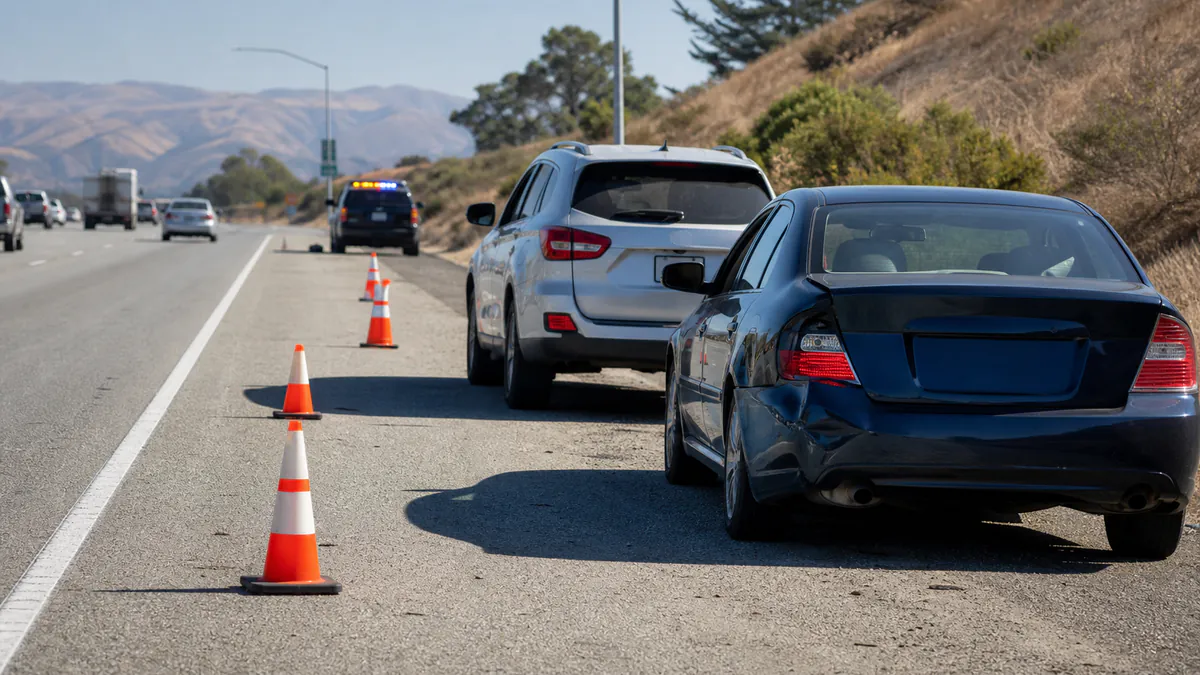
California Vehicle Code §20001–§20004 requires every driver involved in a collision to stop at the scene. The first priority after impact is staying clear of additional danger. On a freeway like I-5 or US-101, that often means steering disabled vehicles onto the right shoulder, behind a guardrail, or to the nearest off-ramp if the car is still drivable. Inside Los Angeles, the Bay Area, or San Diego, surface-street and parking-lot crashes are usually safer to handle in place, away from active lanes.
Turn on hazard lights immediately. If you keep emergency triangles or flares in the trunk, place them 50 to 100 feet behind the vehicle so approaching drivers have time to react. The California Highway Patrol routinely highlights secondary collisions — the crash that follows the first one — as a leading cause of serious freeway injuries.
Stay inside the vehicle with seat belts fastened if traffic is heavy or visibility is poor. Step out only after confirming the area is calm enough to move safely.
Call 911 and Check for Injuries
After securing the scene, call 911 if anyone is injured, unconscious, or trapped inside a vehicle. A 911 call also makes sense any time a crash blocks a lane on a freeway like I-405, I-10, or SR-99, since lane blockage on a major California corridor creates a serious risk of follow-on collisions.
The dispatcher will route the call to the appropriate agency — California Highway Patrol on state highways and most freeways, city police inside municipal limits, and county sheriff's deputies in unincorporated areas of the Central Valley and similar regions. Give the dispatcher the nearest mile marker, off-ramp, exit number, or cross street so responders can locate the scene quickly.
While waiting, check yourself first, then passengers, then anyone in the other vehicle. Adrenaline can mask serious injuries during the first few minutes — especially soft-tissue, whiplash, and concussion symptoms that surface hours later. Do not move anyone with possible spinal or neck injuries unless there is an immediate fire, smoke, or roadway hazard.
Contact California Law Enforcement
California does not require a police response to every crash, but officer involvement adds an independent record that insurers and courts rely on. The California Highway Patrol handles collisions on state-numbered routes and most freeways. City police departments respond inside their jurisdictions, and county sheriff's deputies cover unincorporated regions of Orange County, San Diego County, and similar areas.
Officers usually generate a Traffic Collision Report (CHP 555 or an equivalent local form) when there is injury, fatality, hazardous-materials involvement, suspected impaired driving, or a hit-and-run. For minor property-damage-only crashes — a low-speed parking-lot tap in Sacramento, for example — responding officers may decline to write a full report and instead instruct drivers to exchange information and file an SR-1 with the DMV.
Request the report number before officers leave. You and your insurer will use that number to retrieve the full report later, typically within ten business days through the issuing agency's records portal.
Exchange Information Properly
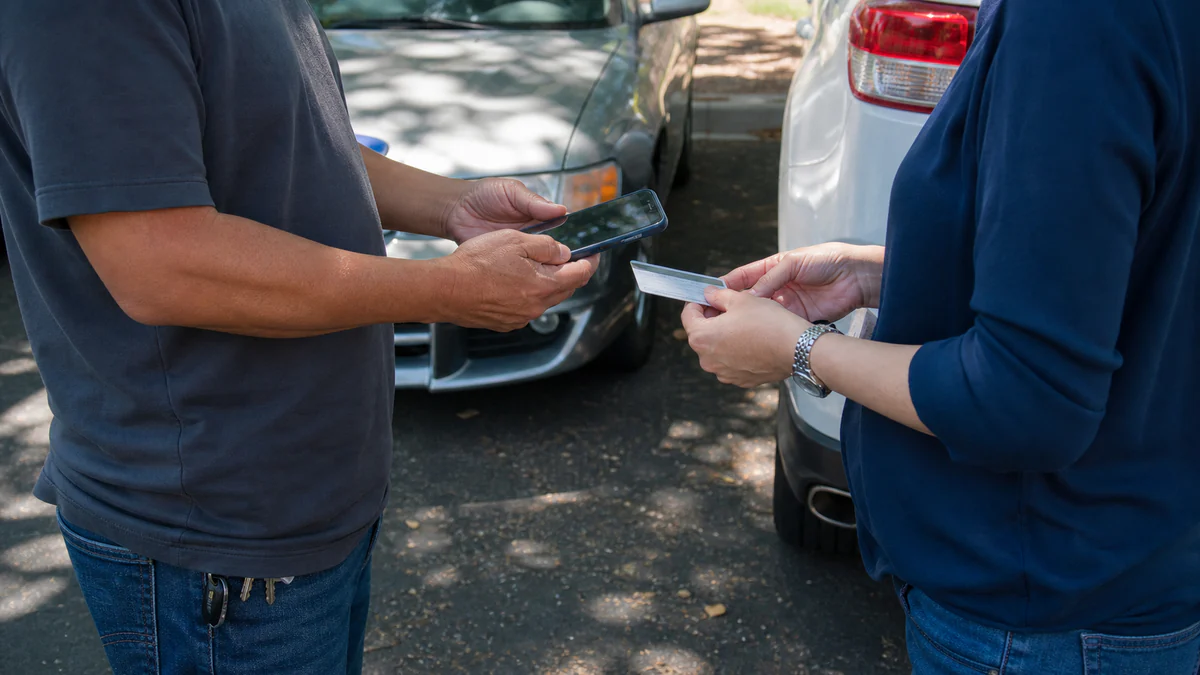
California Vehicle Code §16025 requires drivers involved in a crash that causes injury or property damage to exchange their full name, current residence address, driver's license number, vehicle registration, and the name and address of the registered owner if different. Insurance company name and policy number must also be shared. The same rule applies whether the crash is a freeway sideswipe on I-80 or a low-speed lane-change collision on SR-99.
Use a smartphone camera to capture each document directly rather than copying numbers by hand. License, registration, and the proof-of-insurance card all photograph in seconds. Confirm phone numbers by calling the other driver's phone while still at the scene.
Avoid statements about fault. Saying "I'm sorry" or "I didn't see you" can be quoted later by an adjuster handling the claim. Stick to factual details — direction of travel, lane position, approximate speed at impact — and save legal characterization for the police report and your own insurer.
Gather Evidence at the Scene
Photographic evidence often becomes the strongest part of a California car accident file. Walk a full circle around both vehicles and capture wide, medium, and close shots — the position of vehicles before they are moved, license plates, debris fields, skid marks, traffic signals, and surrounding signage. Include time-stamped photos of weather conditions and road surface, since rain on a Sacramento commute or fog along I-5 in the Central Valley can be material to liability.
Collect contact information from any witness who saw the impact. Independent witnesses — drivers who were not involved and have no relationship to either party — carry the most weight with adjusters and California courts. Note their full name, phone number, and a brief one- or two-sentence summary of what they observed.
If a nearby business or residence has visible camera coverage, write down the address while you are still at the scene. Owners may overwrite footage within days.
Why Photos and Witnesses Matter
Insurance adjusters review claims weeks after the crash, when memories fade and skid marks disappear. Date-stamped photos document conditions the way they actually were. Witness statements collected in the first hour are also more credible than recollections taken months later, because witnesses can describe what they saw without later influence from either party or counsel. In multi-vehicle pileups on the I-10 or rideshare collisions in San Francisco, preserved scene evidence often determines whether a claim settles or proceeds toward litigation.
Seek Medical Attention Quickly
See a physician within 24 to 72 hours, even when injuries appear minor. Concussion symptoms, whiplash, soft-tissue strain, and internal injuries frequently emerge a day or two after the impact. Delayed medical care creates a documentation gap that insurers regularly use to argue that injuries were unrelated to the crash.
Emergency departments, urgent-care clinics, and primary-care offices throughout California treat post-collision patients. Tell the provider the date, time, and mechanism of the crash, including direction of impact and approximate speed. Mention every symptom — neck stiffness, headaches, dizziness, low back pain, ringing in the ears, abdominal tenderness — even if mild. These notes become part of the medical record, which is the most persuasive evidence of injury in a personal injury claim.
Keep copies of discharge instructions, prescriptions, imaging reports, and physical-therapy referrals. Save every receipt for medication, mileage to appointments, parking, and out-of-pocket charges, since these are recoverable in a properly documented California injury claim.
California SR-1 DMV Reporting Rules
California requires drivers to file a Report of Traffic Accident Occurring in California — known as the SR-1 — separately from any law-enforcement report. The obligation is on the driver, not the officer, and the rules apply to every California-licensed driver involved in a qualifying crash regardless of fault.
The SR-1 is submitted to the California Department of Motor Vehicles. It is available as a fillable PDF on the DMV Forms section and can be mailed to the Financial Responsibility Mail Unit listed on the form. Insurers sometimes complete and submit the form on a customer's behalf, but the legal responsibility remains with the driver.

When SR-1 Is Required
Under California Vehicle Code §16000, an SR-1 must be filed within 10 days of any crash that results in injury (no matter how minor), death, or property damage exceeding $1,000 to any single party. Both thresholds are independent — an injured pedestrian alone triggers the requirement, and so does paint and bumper damage that crosses the $1,000 line on a single vehicle. The 10-day clock runs from the date of the collision, not the date of discovery, so prompt assessment of damage value matters.
What Happens If You Don't File
Failure to file an SR-1 within the 10-day window can result in suspension of driving privileges under California Vehicle Code §16004. The DMV may also restrict the registration of involved vehicles until proof of financial responsibility is submitted, with reinstatement fees added on top. The SR-1 is informational only — filing it is not an admission of fault, and the DMV does not use it to assign liability.
When and How to Notify Your Insurance
Most California auto policies contain a prompt-notice clause requiring the insured to report a collision "as soon as reasonably possible." In practice, that means contacting the insurer the same day or within 24 hours of the crash. Delayed reporting gives the carrier grounds to question coverage under the policy's cooperation provisions.
When calling, provide the date, time, and location of the crash, the names and contact information of every driver, witnesses if known, the police report number, and a brief factual summary. Avoid speculation about fault. The adjuster's first questions are designed to lock in your account before you have reviewed the police report or seen medical findings.
California's fair-claims-handling regulations, enforced by the California Department of Insurance, require carriers to acknowledge a claim within 15 calendar days and accept or deny it within 40 days of receiving proof of loss. Understanding filing an insurance claim timelines helps drivers spot improper delays or undocumented denials early.
California Comparative Negligence Explained
California follows a pure comparative negligence rule, adopted in Li v. Yellow Cab Co. (1975). Each party's recovery is reduced by their share of fault — but unlike states with modified rules, a California driver who is 80% at fault can still recover 20% of their damages. The rule applies in court cases and in most insurance settlement negotiations.
A typical example: a driver merging onto I-405 fails to yield and is rear-ended by a driver traveling well above the posted limit. A jury or adjuster might assign 60% fault to the merging driver and 40% to the speeding driver. If total damages equal $50,000, the merging driver recovers $20,000, and the speeding driver can also pursue a claim reduced by their own share of fault.
Adjusters apply comparative negligence early in settlement discussions, often before liability is fully investigated. Photographic evidence, witness statements, and the police report all influence the eventual percentage. Drivers who understand comparative negligence rules are better positioned to push back on inflated fault assignments during negotiation.
Uninsured and Underinsured Motorist Situations
California auto insurers are required to offer uninsured-motorist (UM) and underinsured-motorist (UIM) coverage with every new auto policy under California Insurance Code §11580.2. Drivers can decline the coverage in writing, but failure to decline means the policy automatically includes it at the same limits as the bodily-injury liability portion.
UM coverage applies when the at-fault driver carries no liability insurance — a documented problem in California traffic. UIM coverage applies when the at-fault driver's policy limits are insufficient to cover the actual damages, paying the gap up to the injured driver's own UIM limit.
UM/UIM claims are filed against the injured driver's own carrier, but the carrier acts as the adverse party in determining liability and damages. Many California drivers do not realize they carry this coverage until after a crash. Reviewing uninsured motorist coverage before any incident occurs is a straightforward way to confirm the protection actually in place.
Hit-and-Run Accidents in California
California Vehicle Code §20001 makes it a felony for a driver to leave the scene of a crash involving injury or death, with penalties ranging from one year in county jail to four years in state prison. Vehicle Code §20002 treats property-damage-only hit-and-runs as a misdemeanor.
If you are the victim of a hit-and-run — common in dense urban settings like downtown Los Angeles, San Francisco, and San Diego — call 911 immediately. Note the fleeing vehicle's make, model, color, and partial or full license plate, along with direction of travel. Photograph any debris left at the scene, including broken plastic, paint transfer, and license-plate fragments, since these often help investigators identify the fleeing vehicle later.
Hit-and-run damages may be covered by uninsured-motorist coverage if the policy includes UM-property-damage or UM-collision endorsements. The 10-day SR-1 filing requirement still applies. File a police report regardless of whether the fleeing driver is identified, since the report is required for most insurance and victim-compensation claims.
Rideshare Accidents: Uber and Lyft
Rideshare collisions trigger an insurance structure that differs from ordinary California auto claims. Under California Public Utilities Commission rules governing transportation network companies, every TNC operating in the state — Uber, Lyft, and licensed competitors — must carry $1 million in third-party liability coverage while a driver is actively transporting a passenger or en route to a pickup.
When a driver is logged into the app but has not yet accepted a ride, lower limits apply (typically $50,000 per person and $100,000 per accident for bodily injury, plus $30,000 in property-damage coverage). When the app is off, only the driver's personal policy responds, and most personal policies exclude rideshare driving without a specific endorsement.
For passengers and other motorists injured in a rideshare crash in San Francisco, Oakland, or Los Angeles, claims are usually filed against the TNC's liability carrier rather than the driver personally. Saving screenshots of the ride receipt, driver name, and trip status preserves the strongest path to the correct insurance layer.
Important Legal Deadlines
California sets specific deadlines that decide whether a claim can move forward at all. Code of Civil Procedure §335.1 gives injured drivers two years from the date of the crash to file a personal injury lawsuit. Property damage claims have a three-year window under Code of Civil Procedure §338.
Crashes involving a public entity — a city bus collision in Sacramento, a Caltrans road-design issue on I-5, or a county vehicle in Orange County — fall under the California Government Claims Act. Government Code §911.2 requires a written claim to be presented to the public entity within six months of the incident. Missing the government-claim deadline ordinarily bars the lawsuit entirely.
The SR-1 reporting deadline of 10 days runs in parallel with everything else. Insurance notification deadlines depend on policy language but typically run from a few days to a few weeks. Drivers handling overlapping deadlines — particularly with truck accident claims involving commercial carriers — benefit from speaking with a California attorney before any of the windows close.
Common Mistakes Drivers Make
Several recurring errors weaken California car accident claims long before they reach settlement:
- Apologizing or admitting fault at the scene. A statement made under stress can be treated as an admission, even when the speaker did not intend to accept legal responsibility.
- Skipping medical evaluation. Insurers regularly argue that a gap of more than a few days between the crash and the first medical visit means the injuries arose from another cause.
- Giving recorded statements to the other driver's insurer. California drivers are not obligated to provide a recorded statement to a third-party carrier and can usually defer until liability has been investigated.
- Accepting the first settlement offer. Initial offers often exclude future medical care, future lost earnings, and the long-tail effects of soft-tissue injuries.
- Posting on social media. Adjusters routinely review public posts for content inconsistent with claimed injuries, especially in motorcycle accident guide cases and other claims with visible injury components.
- Missing the SR-1 deadline. The 10-day clock catches drivers who assumed the police report satisfied DMV reporting — it does not.
When It Makes Sense to Speak With a Lawyer
Not every California crash needs an attorney. Low-speed parking-lot scrapes with no injuries and clear liability often resolve directly through the insurers. The calculus changes when injuries, disputed fault, or commercial parties enter the picture.
Consultation with a California-licensed personal injury attorney usually makes sense when any of the following applies: hospitalization or surgery is involved; the other driver was on the job or operating a commercial vehicle; the crash involves a government entity or rideshare company; the insurer denies coverage or makes an unusually low first offer; or fault is contested under comparative negligence principles.
Most California personal injury attorneys offer free initial consultations and work on a contingency basis — typically one-third of recovery if the case settles before suit, increased after litigation begins. The State Bar of California licenses every practicing attorney, and license status and disciplinary history are searchable on the State Bar's public records portal. Cases involving bicycle accident rights and pedestrian injuries follow similar evaluation principles, with vulnerable-road-user dynamics adding nuance to liability.
Quick Emergency Checklist
A printable scene-to-DMV checklist for California drivers:
- Stop the vehicle in a safe location and turn on hazard lights.
- Call 911 if anyone is injured or a lane is blocked.
- Check yourself, passengers, and other drivers for injury.
- Exchange license, registration, insurance, and contact information.
- Photograph the vehicles, license plates, the wider scene, road conditions, signs, signals, and any visible injuries.
- Collect witness names, phone numbers, and a brief statement of what they saw.
- Request the police report number before officers leave the scene.
- See a doctor within 24 to 72 hours, even for symptoms that seem minor.
- Notify your insurance company within 24 hours of the crash.
- File an SR-1 with the California DMV within 10 days if injury, death, or over $1,000 in property damage occurred.
- Track every medical, repair, transportation, and lost-wage expense in a single folder.
- Keep police, medical, and insurer correspondence in writing whenever possible.
Official California Resources
Bookmark these official sources for current California car accident procedures:
- California Department of Motor Vehicles — SR-1 form, accident reporting, and licensing.
- California Highway Patrol — collision reports and freeway safety information.
- California Department of Insurance — claims handling rules and the consumer complaint process.
- California Courts Self-Help — small claims, civil cases, and personal injury basics.
- California Legislative Information — Vehicle Code, Insurance Code, and Code of Civil Procedure.
- California Office of Traffic Safety — crash data and statewide safety programs.
- National Highway Traffic Safety Administration — federal crash safety standards and recalls.
- Centers for Disease Control and Prevention — motor vehicle injury data.
State and federal information evolves. Confirm any procedure on the official site before acting on it, and speak with a California-licensed attorney before relying on this guide for any specific claim.

Frequently Asked Questions
Do I have to call the police after a minor accident in California?
How long do I have to report a car accident to the DMV in California?
What happens if I don't file an SR-1 in California?
How does comparative negligence work in California?
What is California's minimum auto insurance requirement?
Should I see a doctor after a minor crash if I feel fine?
How long do I have to file a car accident lawsuit in California?
What should I do if the other driver doesn't have insurance?
More Car Accidents Guides

Property Damage Claim After a Car Accident
Organize repair estimates, vehicle valuations, rental and storage records after a crash. Includes claim tools and clearly labelled state examples.

Intersection Accident Fault
A legal guide to intersection accident fault, including right-of-way rules, evidence collection, and liability analysis.

Car Accident With No Insurance
A legal guide to car accidents involving uninsured drivers, including coverage options, penalties, and claim strategies.

Car Accident Lawyer Near Me: A Step-by-Step Hiring Blueprint
A step-by-step blueprint for hiring a local car accident lawyer, including documentation, evaluation, and decision checkpoints.

Sideswipe Accident Claims Guide
Sideswipe accident claim guide covering lane changes, blind spots, merging, comparative fault, vehicle damage, medical records, and insurance.

What Is My Car Accident Case Worth?
How car accident case value is determined — economic and non-economic damages, the multiplier, what raises or lowers value, and why averages mislead.
Claim Organization Tools
View all toolsUse these worksheets to organize evidence, treatment records, and insurance deadlines for a car-accident claim.
Car Accident Lost Wages Calculator Google Sheets
It ties missed work and pay disruption back to the injury period instead of treating wage loss like a rough estimate.
Use it when missed shifts, reduced hours, or future work limits need to be backed by dates, rates, and employer proof.
Car Accident Checklist Google Sheets
It captures first-day facts before details in a car crash claim file scatter across notes, photos, texts, and claim calls.
Use it immediately after the event, while scene facts, contacts, and initial documentation are still easy to capture cleanly.
Car Accident Evidence Log Google Sheets
It keeps each proof item tied to a source, date, and why-it-matters note instead of leaving evidence loose in folders.
Use it when proof quality is the bottleneck and every photo, statement, or record needs a source trail.
Car Accident Repair Cost Tracker Google Sheets
It organizes repair, replacement, and gear-loss evidence so property damage is not reconstructed later.
Use it when repair estimates, police-report details, insurer claim numbers, and scene documentation include repair or replacement issues that need their own paper trail.
Guides for this topic

Continue Exploring
Keep moving through the topic with the next guide, the category hub, or a related calculator.
Found this useful?
Share this guide
Send this guide to anyone weighing an accident or insurance claim — it stays free, with no email gate.
Keep learning
Follow for more accident and insurance education
Short legal explainers on TikTok, visual case briefs on Instagram, daily threads on Threads.
Information only — not legal advice.
Editorial Accountability
About this guide and its AI host
JusticeFinder publishes this educational guide. Sophia Hayes is its educational AI host, not a licensed legal professional. Learn about source verification and editorial standards through the JusticeFinder Editorial Team profile and the sources cited in this guide.
- Scope: Educational legal information only, not legal advice
- Last editorial update: May 18, 2026

Sophia Hayes
Educational Accident & Insurance Awareness Host
Sophia Hayes is JusticeFinder's educational AI host and documentary-style narrator covering U.S. accident law, insurance literacy, and public safety. She is not a lawyer, attorney, legal representative, medical professional, or insurance adjuster.
View AI host profile