
Can I Sue After Workers Compensation? Third-Party Liability Explained
Can I Sue After Workers Compensation is the core question when a job injury involves a third party outside the employer. Can I Sue After Workers' Compensation is also a common entry point for cases that overlap with construction accident lawyer analysis under OSHA standards. This guide explains the legal framework for third-party liability, the evidence required to prove negligence, and the way workers compensation exclusivity interacts with civil claims. It also clarifies when a third-party claim can proceed as a third-party lawsuit or personal injury claim, how a workplace injury lawsuit is structured, and why suing for work injury typically depends on a provable negligence claim. Liability theories often include premises liability, product liability, an equipment defect, or contractor negligence. Claim value is shaped by comparative fault, early evidence preservation, and how any subrogation lien is handled. It is written for workers and families who need a disciplined method for case analysis, records control, and damages planning under U.S. law. The focus stays on practical steps, claim sequencing, and evidence discipline that supports litigation decisions.
This overview explains how Can I Sue After Workers' Compensation considerations shape evidence, liability, and recovery planning.
Can I Sue After Workers Compensation: Legal Framework
Workers compensation is a state-based system that provides medical and wage benefits without a fault finding. In exchange, most states apply an exclusivity rule that limits lawsuits against the employer. Third-party liability remains available when a negligent entity outside the employer caused or contributed to the injury. The legal framework therefore combines workers compensation statutes, tort law, and civil procedure rules.
Key official sources include U.S. Department of Labor OWCP for federal workers compensation programs, OSHA safety resources for regulatory context, USA.gov workers compensation overview, and U.S. Courts official resources for federal court structure.
Can I Sue After Workers Compensation: Core Definitions
Exclusive remedy The statutory rule that limits a workers lawsuit against an employer in exchange for statutory benefits.
Third-party claim A civil action against a non-employer entity whose negligence or defect caused injury.
Subrogation lien The right of a workers compensation insurer to recover amounts paid from a third-party recovery.
Allocation The division of settlement proceeds among damages categories, often relevant to lien reductions.
Can I Sue After Workers Compensation: Federal and State Structure
States define the scope of exclusivity, the definition of employer, and the exceptions that permit direct lawsuits. Federal workers, such as those covered under FECA, follow different rules for benefits and limits on suits. A careful case review identifies the worker's status, the employer structure, and the jurisdiction that controls both the benefit claim and any third-party case.
Can I Sue After Workers Compensation: Government Records and Agency Data
Government records help establish the worksite context. OSHA inspection reports, agency citations, and incident logs often support the liability analysis. Requests should be made early to align with agency retention schedules and public record procedures.
Can I Sue After Workers Compensation: Liability Factors Overview
Third-party liability often arises from equipment defects, contractor negligence, premises hazards, or vehicle collisions. The liability map should align the duty, breach, and causation analysis with each non-employer entity involved.
Can I Sue After Workers Compensation: Micro-Checklist for Legal Fit
Documented third-party recovery history in workplace injury cases. Experience with workers compensation liens and allocation disputes. Access to safety, engineering, and medical experts. Structured evidence preservation plan for equipment and site data. Trial readiness with a clear verdict record.
Can I Sue After Workers Compensation: Liability Analysis
Liability analysis starts by separating employer conduct from third-party conduct. The employer's role often remains within the workers compensation system, while third parties face tort liability. The analysis requires a timeline that aligns worksite events, safety controls, and equipment use with the injury mechanism.
Can I Sue After Workers Compensation: Common Third-Party Theories
- Premises liability: unsafe conditions at a jobsite controlled by a property owner.
- Equipment defect: design or manufacturing defect in tools, machinery, or vehicles.
- Product liability: claims against manufacturers or suppliers for unsafe products.
- Contractor negligence: unsafe work practices by another contractor or subcontractor.
- Motor vehicle negligence: collisions involving a non-employer driver.
- Professional negligence: errors by an outside engineer, inspector, or safety consultant.
Can I Sue After Workers Compensation: Comparative Fault Strategy
Some states apply comparative fault rules that reduce recovery by a workers percentage of fault. A disciplined approach relies on objective records: safety training logs, equipment manuals, maintenance records, and site control documentation. The goal is to place responsibility on the third party rather than the worker or employer.
Can I Sue After Workers Compensation: Liability Matrix
Use this framework to align evidence and defense patterns to each liability issue:
-
Equipment defect Core evidence: maintenance logs, component inspection, and product history. Defense pattern: claims of misuse or alteration. Attorney response: engineering analysis and preservation proof.
-
Premises hazard Core evidence: site photos, inspection records, and hazard logs. Defense pattern: claims of open and obvious conditions. Attorney response: prior notice records and safety standards analysis.
-
Contractor negligence Core evidence: work orders, safety plans, and scopes of work. Defense pattern: claims of employer control. Attorney response: contract review and site control proof.
-
Vehicle collision Core evidence: crash report, telematics, and witness accounts. Defense pattern: claims of worker fault. Attorney response: reconstruction and right-of-way analysis.
Can I Sue After Workers Compensation: Evidence Handling
Evidence handling is critical because third-party claims often depend on physical items and time-sensitive data. A structured plan preserves equipment, documents the worksite, and controls the chain of custody. The plan should be written and updated as discovery progresses.
Can I Sue After Workers Compensation: Preservation and Chain of Custody
Preservation letters should go to employers, property owners, equipment vendors, and insurers. The letters should identify the equipment or site element to be preserved and request that no repairs or alterations occur. A chain-of-custody log should track each transfer and inspection.
Can I Sue After Workers Compensation: Worksite and Equipment Documentation
Worksite evidence includes photos of hazards, layout measurements, and signage. Equipment evidence includes serial numbers, maintenance records, and inspection logs. When a defect is suspected, a joint inspection protocol reduces later disputes about alterations.
Can I Sue After Workers Compensation: Medical Evidence Standards
Medical evidence must link injury mechanism to the worksite event. The file should include emergency records, diagnostic imaging, operative reports, therapy notes, and functional limitations. Independent medical experts often clarify medical causation and future care needs.
Can I Sue After Workers Compensation: Evidence Priorities
Focus on the following evidence items and preservation actions:
-
Equipment or tool Why it matters: defect analysis and use conditions. Typical holder: employer or vendor. Preservation action: secure storage and joint inspection.
-
Site photos Why it matters: hazard documentation. Typical holder: worker or investigator. Preservation action: same-day photography.
-
Safety plans Why it matters: duty and control allocation. Typical holder: contractor or owner. Preservation action: record request and copy log.
-
Incident reports Why it matters: initial narrative and timing. Typical holder: employer or site owner. Preservation action: preservation letter and request.
-
Medical imaging Why it matters: causation and prognosis. Typical holder: hospital or clinic. Preservation action: full imaging set and reports.
Can I Sue After Workers Compensation: Evidence Workflow Steps
Secure the equipment and document any warning labels or modifications. Photograph the worksite from multiple angles and measure hazard distances. Request safety plans, work orders, and contractor scopes of work. Order medical records and imaging in full. Maintain a written chain-of-custody log.
Can I Sue After Workers Compensation: Expert Selection Framework
Third-party litigation often depends on expert testimony that explains safety standards, defect mechanisms, and medical causation. An expert framework should align each expert with a specific liability issue and a specific proof need. The framework should also include credential checks, prior testimony review, and budget planning for depositions and trial.
Safety or engineering expert Defines safety standards, equipment design requirements, and hazard control duties.
Reconstruction expert Models the incident sequence using measurements, photos, and physical evidence.
Medical causation expert Links the worksite event to the injury mechanism, treatment path, and prognosis.
Vocational expert Evaluates work restrictions, transferable skills, and earning capacity loss.
Economic damages expert Projects lost income, fringe benefits, and life care costs.
Each expert should receive a focused record set and a clear set of opinions to address. This structure reduces overlap and strengthens admissibility under state evidence rules.
Can I Sue After Workers Compensation: Insurance Structure
Insurance structure determines recovery scope. Third-party cases often involve commercial general liability coverage, auto liability coverage, and umbrella policies. The workers compensation carrier also holds a lien for benefits paid. A coverage map should identify all insurance coverage, limits, and notice deadlines.
Can I Sue After Workers Compensation: Coverage Map
Use this coverage overview to organize insurance coverage and claim risks:
-
Commercial general liability Typical source: property owner or contractor. Claim use: premises liability or contractor negligence. Key risks: coverage exclusions and notice rules.
-
Auto liability Typical source: non-employer driver. Claim use: vehicle collision recovery. Key risks: low limits and disputed liability.
-
Umbrella or excess Typical source: corporate policy. Claim use: high value claims. Key risks: attachment points and exclusions.
-
Workers compensation lien Typical source: employer carrier. Claim use: reimbursement claim. Key risks: allocation disputes and repayment terms.
Can I Sue After Workers Compensation: Lien Resolution Strategy
Lien resolution is a core part of third-party planning. State statutes govern how liens attach and how reductions are negotiated. A disciplined approach documents procurement costs, comparative fault exposure, and settlement allocation to support lien reduction.
Can I Sue After Workers Compensation: Settlement Demand Structure
A demand package should include a liability summary, medical chronology, and a damages valuation range. Policy limits documentation and lien status should be included to reduce late-stage disputes. A firm response deadline supports timely evaluation and positions the case for mediation.
Can I Sue After Workers Compensation: Allocation and Settlement Structure
Allocation describes how settlement funds are assigned to damages categories. Proper allocation supports lien reduction and protects the worker's net recovery. The allocation should match the medical record and wage documentation, with clear support for non-economic loss categories. A structured approach also limits disputes between insurers and third parties during settlement finalization.
Allocation categories typically include:
- Past medical costs supported by itemized bills and EOBs.
- Future care supported by life care plans and physician opinions.
- Wage loss supported by payroll and tax records.
- Non-economic loss supported by therapy notes and impact logs.
- Out-of-pocket costs supported by receipts and travel logs.
Can I Sue After Workers Compensation: Coordination With Benefit Claim
Third-party litigation must align with the workers compensation benefit file. Medical updates, impairment ratings, and return-to-work records inform both systems. A coordinated timeline prevents conflicts in medical narratives and supports consistent causation proof. When a third-party settlement occurs, the benefit file should reflect lien terms and any credit applied to future benefits.
Can I Sue After Workers Compensation: Damages Valuation
Damages valuation in third-party cases covers categories not paid by workers compensation, such as pain and suffering. A structured valuation uses medical evidence, wage records, and long-term care projections. The analysis should identify both economic and non-economic categories with supporting documentation.
Can I Sue After Workers Compensation: Damages Categories
- Medical expenses: treatment costs not covered or subrogated.
- Lost income: wage loss beyond workers compensation benefits.
- Future care: projected treatment, therapy, and assistive devices.
- Non-economic loss: pain, loss of normal life, disfigurement.
- Out-of-pocket costs: travel, equipment, and related expenses.
Can I Sue After Workers Compensation: Damages Calculation Framework
Use a consistent record set for each category:
- Past medical costs: bills and EOBs with provider detail.
- Future care: care plan and physician support.
- Wage loss: payroll records and tax returns.
- Earning capacity: vocational analysis and labor market data.
- Non-economic loss: impact narrative and therapy notes.
Can I Sue After Workers Compensation: Future Care and Earning Capacity
Severe injuries require a life care plan and a vocational assessment. The life care plan should list treatment frequency, equipment replacement cycles, and attendant care needs. A vocational expert should document work restrictions, transferable skills, and retraining costs.
Can I Sue After Workers Compensation: Non-Economic Proof Methods
Non-economic damages require consistent documentation of daily impact. Evidence sources include therapy records, activity logs, and statements that align with medical assessments. Consistency across records strengthens credibility during mediation and trial.
Can I Sue After Workers Compensation: Procedure Timeline
Procedure timelines vary by state, yet a consistent sequence applies. A written timeline with deadlines supports record collection, expert review, and timely filing.
Can I Sue After Workers Compensation: Timeline Stages
Initial intake: record authorization, preservation letters, and basic chronology. Evidence collection: site records, equipment preservation, and medical records. Expert review: liability, safety, and medical causation analysis. Pre-suit steps: notice requirements and lien identification. Filing: complaint filed and service completed. Discovery: depositions, document production, and expert reports. Motions: evidentiary and dispositive motions. Mediation: settlement conference with updated damages. Trial: jury selection, testimony, and verdict.
Can I Sue After Workers Compensation: Discovery Targets
Discovery should focus on contracts, safety plans, equipment maintenance records, and site control documents. Depositions often include site supervisors, contractors, and safety officers. Expert discovery should address defect analysis, safety standards, and medical causation.
Can I Sue After Workers Compensation: Mediation Readiness Package
Mediation preparation should include a clear liability narrative, medical chronology, and damages valuation. Coverage limits and lien status should be documented. A structured brief supports settlement leverage and reduces last-minute disputes.
Can I Sue After Workers Compensation: Pre-Suit Filing Checklist
Pre-suit preparation prevents missed deadlines and incomplete filings. A disciplined checklist keeps the case aligned with the statute of limitations and lien requirements.
Confirm the civil statute of limitations for the third-party defendant. Identify any notice rules tied to public entities or contractors. Verify the correct legal entity name and registered agent. Compile the core evidence set and expert engagement letters. Document lien holders and obtain current benefit payment totals.
Can I Sue After Workers Compensation: Decision Tree
Use this decision tree to align attorney selection with case complexity.
Start

 -- Injury caused by non-employer entity or product?
 -- Yes -> Continue
 -- No -> **Third-party claim** unlikely

 -- Physical evidence at risk of alteration or loss?
 -- Yes -> Immediate preservation plan and joint inspection
 -- No -> Continue

 -- Multiple contractors or property owners involved?
 -- Yes -> Require contract and site control review
 -- No -> Continue

 -- Workers compensation lien expected?
 -- Yes -> Require lien strategy and allocation plan
 -- No -> Continue

 -- Fee agreement transparent with cost controls?
 -- Yes -> Retain and begin evidence plan
 -- No -> Continue interview with other counsel
Can I Sue After Workers Compensation: FAQ
What is a third-party claim after workers compensation?
A third-party claim is a lawsuit against a non-employer whose negligence or defect caused the work injury.
How does exclusivity affect a lawsuit?
Summary
Can I Sue After Workers Compensation guide for third-party liability, covering U.S. exclusivity rules, evidence, insurance, and damages strategy. Read our co...
Quick Legal Answer: What this guide covers
Can I Sue After Workers Compensation guide for third-party liability, covering U.S. exclusivity rules, evidence, insurance, and damages strategy. Read our co...
Quick Legal Answer: Core legal focus
This guide focuses on Can I Sue After Workers Compensation within legal process and the evidence, timelines, and standards typically evaluated under U.S. law.
Quick Legal Answer: When to verify with counsel
Because statutes and rules vary by state, confirm the specifics for your jurisdiction with a qualified attorney or official government resources.
Key Takeaways
- Understand the core rules and evidence standards tied to Can I Sue After Workers Compensation.
- Track deadlines and procedural steps that shape recovery options.
- Document medical records, liability proof, and insurance communications early.
- Compare settlement posture with litigation risk based on the case record.
Trial Strategy: The Trial vs. Settlement Decision Matrix
In third-party workplace litigation, the decision to go to trial or accept a settlement is often the most critical point in the case. While workers' compensation provides immediate medical and wage support, a civil trial is the only way to recover "full" non-economic damages. However, trial carries significant risk and cost that must be balanced against the perceived value of the claim.
Use this decision matrix to evaluate the tactical strength of your third-party claim before rejecting an insurance offer:
Table overview: Factor, Favor Settlement, Favor Trial. Factor is Liability Evidence; Favor Settlement is "Shared Fault" or Disputed Mechanics; Favor Trial is Clear, 100% Defendant Liability. Factor is Medical Damages; Favor Settlement is Resolvable or Minor Injuries; Favor Trial is Permanent, Catastrophic, or Life-Altering. Factor is Litigation Risk; Favor Settlement is Low Risk, Immediate Fund Access; Favor Trial is High Cost (Experts/Transcripts), 1-2 Year Delay. Factor is Witness Reliability; Favor Settlement is Weak or Discredited Testimony; Favor Trial is Strong, Persuasive Professional Witnesses. Factor is Insurance Posture; Favor Settlement is "Reasonable" and "Fair" coverage; Favor Trial is Insulting or "Nuisance Value" Low-ball.
Advanced Discovery: The 30(b)(6) Corporate Deposition Script
If your injury was caused by a defective machine or a negligent subcontractor, your lawyer's most powerful tool is the Rule 30(b)(6) deposition. This allows the legal team to question a corporate representative who speaks for the entire company, rather than just an individual worker.
In "Can I Sue After Workers Compensation" cases, the focus is on systemic failures that led to the injury. Below are 4 critical line-of-questioning tracks used to pin down third-party liability:
Safety Training and Certification Records: "Why was the at-fault operator cleared to work without the specific safety certifications required by the manufacturer's manual?" Maintenance and Inspection Logs: "The log book skips the 3 months prior to the accident. Who was responsible for inspecting this equipment, and where are the missing verification signatures?" Internal Risk Communications: "When the supervisor received the initial hazard report 30 days before the injury, what 'Immediate Corrective Action' was documented and funded?" Safety Budgeting Decisions: "Were safety equipment upgrades delayed or denied in the 12 months prior to this incident? Document the decision-making chain for these denials."
Deep Dive: Workers Comp Subrogation and Lien Resolution Tactics
A successful third-party lawsuit doesn't just happen in the courtroom; it happens during the "Lien Wars." When you recover money from a third party, your employer's workers' comp insurer has a right to be reimbursed for the benefits they paid you. This is known as a subrogation lien.
The "Made-Whole" Doctrine
In many jurisdictions, the "Made-Whole" doctrine prevents an insurance company from collecting on their lien if the worker has not been fully compensated for all their losses (pain, suffering, future costs). If your third-party settlement is limited by the defendant's policy caps, your lawyer may argue that you haven't been "made whole," potentially wiping out the insurer's right to take your money.
Allocation Warfare: Protecting Your Net Recovery
Smart legal teams use "Allocation Warfare" to maximize the worker's net check. By specifically assigning portions of the settlement to "Loss of Consortium" (payable to a spouse) or "Future Medical Care," you can often shield these funds from the workers' compensation lien, which typically only attaches to past wage and medical payments.
Reductions via Section 1147 (or State Equivalent)
Most states require the insurer to pay their "fair share" of the attorney's fees and litigation costs from the money they recover through their lien. For example, if your lawyer takes a 33% fee, the insurer's lien should be reduced by 33% automatically because they are benefiting from your lawyer's work.
2025-2026 Workplace Safety Trends and OSHA Regulation Shifts
The legal landscape for "Can I Sue After Workers Compensation" is shifting as OSHA and federal courts prioritize specific industry hazards.
- Construction—"The Fatal Four": Falls, Struck-by, Caught-in/between, and Electrocution remain the top drivers of high-value third-party claims. Attorneys are now using 3D drone mapping to prove "Site Control" negligence by general contractors.
- Logistics and Warehousing: With the rise of ELD automated tracking, "log-jumping" and fatigue-driven injuries are becoming easier to prove as third-party negligence by shippers and brokers who forced unsafe schedules.
- Manufacturing and Automation: As robots and AI-driven machinery enter the worksite, product liability claims against hardware manufacturers are increasing. The focus is on "Lack of Guarding" and software failures that bypass human safety overrides.
Source Box (Official .gov & .edu References)
- U.S. Department of Labor (OWCP): Information on federal workers compensation programs (FECA). View Site
- OSHA (Occupational Safety and Health Administration): Regulatory standards for workplace hazard controls. View Site
- Cornell Law School (LII): Comprehensive overview of Tort Law and Exclusivity rules. View Site
- National Institute for Occupational Safety and Health (NIOSH): Research and data on workplace injury prevention. View Site
- U.S. Bureau of Labor Statistics (BLS): Injury and fatality trends by industry. View Site
Final Checklist: Can I Sue After Workers Compensation?
- [ ] Third-Party Identity: Confirm the at-fault entity is NOT your employer or a direct co-worker.
- [ ] Preservation of Evidence: Send a Spoliation Letter immediately to prevent the "disappearance" of equipment or video logs.
- [ ] Lien Analysis: request the "Itemized Payment History" from the workers comp adjuster early to know your lien exposure.
- [ ] Expert Audit: Ensure your legal team has retained a safety engineer or medical causation expert before filing.
- [ ] Chronology Review: Align your OSHA incident report with your medical emergency records to ensure narrative consistency.
Related Resource: Dog Bite Lawyer: Strict Liability vs One-Bite Rule by State
Related Resource: How to Hire a Motorcycle Injury Lawyer in Las Vegas: Tourist & Local Guide
Related Resources
For broader context, review the Legal Process hub.
Related Guides
- Birth Injury Lawyer: Cerebral Palsy & Medical Malpractice Guide
- Catastrophic Injury Settlements: Life Care Plans & Million-Dollar Claims
- Construction Accident Lawyer: OSHA Violations, Scaffolding & Fall Protection
Pillar guide: Contingency Fee Agreements: 33-40% Standard & Hidden Costs
Helpful Tool
Use the Accident Claim Deadline and Calendar Tracker Google Sheets to organize documentation, expenses, and insurance claim records while applying this guide.
More Legal Process Guides

Uber & Lyft Accident Lawyer: Rideshare Insurance & Liability Guide
Authority guide to Uber & Lyft Accident Lawyer claims under U.S. law, focused on rideshare insurance periods 1, 2, and 3 triggers. Read our comprehensive and...

Should I Settle or Go to Trial? Personal Injury Case Decision Guide
Authority guide for Should I Settle or Go to Trial? Personal Injury Case Decision Guide, focused on U.S. liability proof, valuation, and trial risk. Read our...

Personal Injury Discovery: Interrogatories, Depositions & Document Requests
Personal Injury Discovery guide to interrogatories, depositions, document requests, evidence control, and U.S. civil procedure timing. Read our comprehensive...
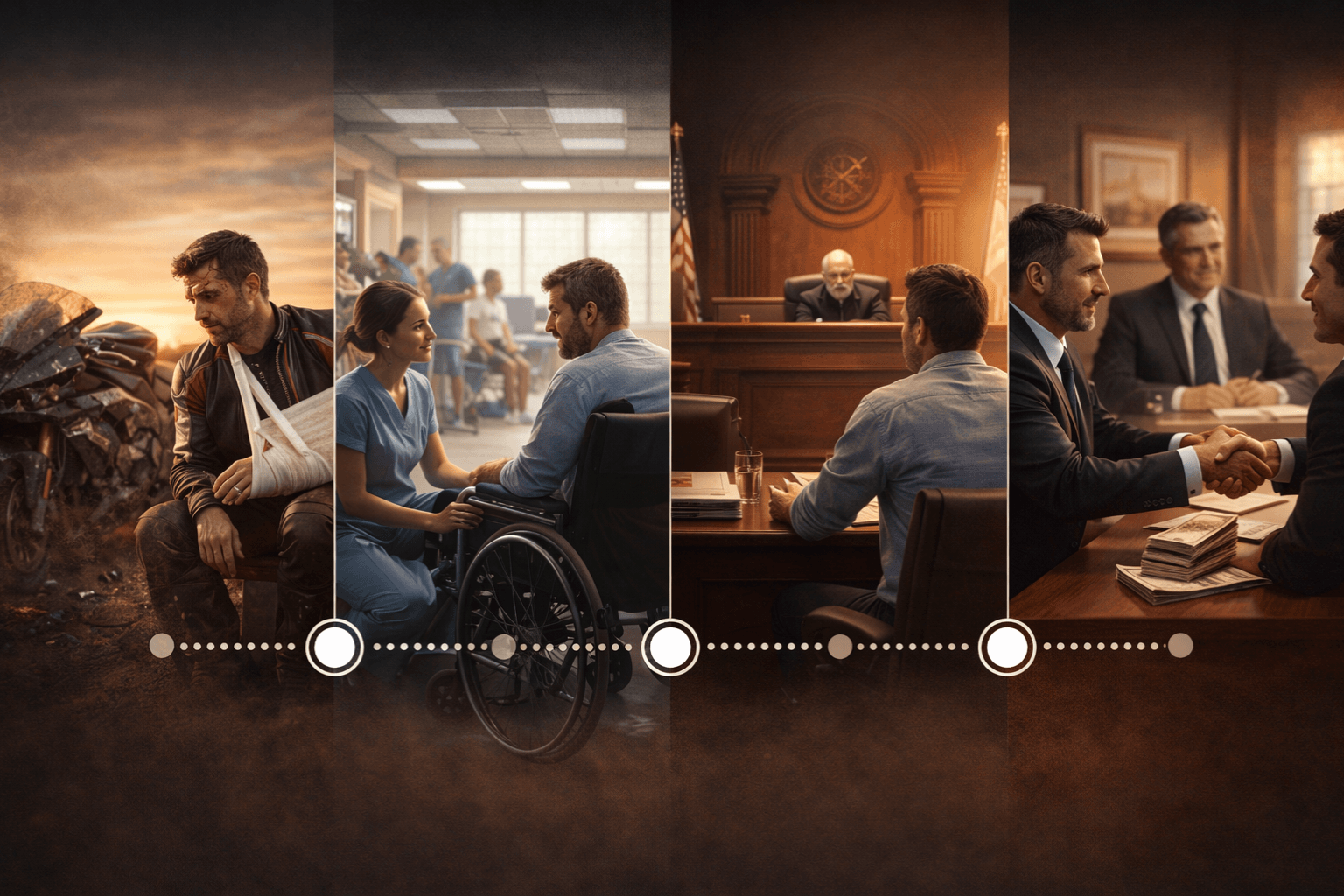
Motorcycle Personal Injury: What to Expect (9-Month Roadmap)
Master the motorcycle injury claim process. A 9-month roadmap from a motorcycle personal injury lawyer covering evidence stabilization, demand planning, and ...

Jones Act Lawyer: Seaman Injury Claims & Maritime Negligence
Expert guide on maritime law. Learn how a Jones Act lawyer handles seaman injury claims, unseaworthiness, and maintenance and cure recoveries under federal m...

Construction Accident Lawyer: OSHA Violations, Scaffolding & Fall Protection
Construction Accident Lawyer guide covering OSHA violations, scaffolding, fall protection, evidence, insurance, damages, and U.S. procedure. Read our compreh...
Related Documentation Tools
View all toolsThese free spreadsheets help organize evidence, deadlines, and claim documentation for this topic.
Personal Injury Statute of Limitations Tracker Google Sheets
Keep legal timing visible so filing and response windows are not missed with Claim Overview and State SOL Reference before you share records with an insurer or attorney.
Personal Injury Expense and Damages Tracker Google Sheets
Track income disruption with records adjusters and attorneys can review quickly with Claim Overview and Economic Damages before you share records with an insurer or attorney.
Personal Injury Case Preparation Checklist Google Sheets
Build a timestamped evidence file that keeps facts consistent with Case Overview and Case Checklist before you share records with an insurer or attorney.
Settlement Demand Letter Organizer Google Sheets
Estimate negotiable case value and keep damages evidence aligned with Claim Overview and Economic Damages before you share records with an insurer or attorney.