One-Time Price
$27.00
No subscription
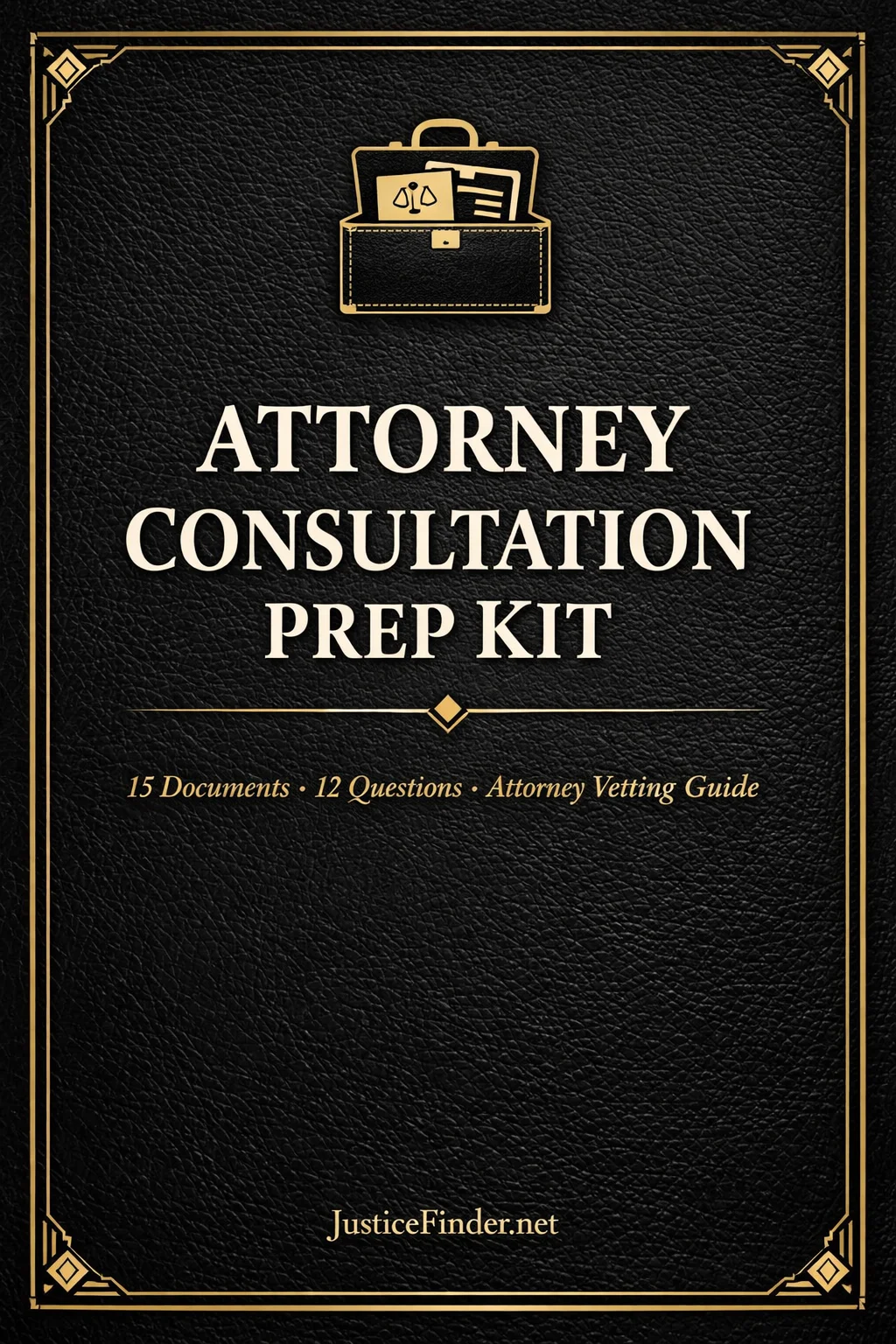
A free attorney consultation is a job interview — yours. Walk in with organized records, targeted questions, and a clear framework for deciding whether this attorney is the right one for your case.
One-Time Price
$27.00
No subscription
Format
Protected PDF
Print or digital use
Delivery
Instant
After payment verified
The Problem
Claimants waste free consultations by arriving unprepared, not knowing what to bring, saying the wrong things, or failing to evaluate attorney quality before signing a contingency agreement.
Built for:
Injury victim preparing for a first meeting with a personal injury attorney.
The Solution
Delivers a pre-consultation document checklist, 25 questions to ask the attorney, a contingency fee evaluation guide, and a post-meeting decision framework in one printable PDF.
Document checklist covering what every attorney wants to see at intake — and why.
25 vetted questions that reveal case strategy, fee structure, and caseload reality.
Contingency fee evaluation guide and post-meeting decision matrix.
What's Inside
Who This Is For
What You'll Learn
Why This Matters Now
Insurance companies open their claim file the day of your accident. Every day you wait without a system is a day they build theirs. This guide is not about reading — it is about taking the right actions before leverage is permanently lost.
Source Anchors
This guide references official government sources, not opinion.
USAGov Consumer Complaint Routing
Official starting point for vehicle and consumer complaint escalation paths.
NHTSA Traffic Records Standards
Crash-documentation and reporting fields that shape evidence quality.
CMS Medicare Secondary Payer Recovery
Official Medicare recovery workflow relevant to settlement timing and lien math.
Free Tools That Pair With This Guide
Frequently Asked Questions
Bring the police or incident report, all medical bills and records organized by date, proof of lost wages, insurance correspondence, photos of injuries and the accident scene, and any demand letters or claim numbers. The Kit's intake checklist covers all 14 document categories attorneys want to see at the first meeting.
Ask about their experience with your injury type, how many cases like yours they have taken to trial, who will actually work your case, what their fee structure is, how long they estimate your case will take, and what their honest assessment of your liability is. The Kit includes 25 vetted questions organized by category.
A contingency fee agreement means the attorney only gets paid if you recover money — typically 25–40% of the gross settlement. Watch for: fee percentage that increases after lawsuit is filed, cost deductions taken before or after fee calculation, and clauses about who pays costs if the case loses. The Kit explains each term in plain language.
Evaluate them on: their honest (not inflated) assessment of your case strength, the specificity of their strategy rather than generic promises, who handles your file day-to-day, their communication practices, and how clearly they explain the contingency agreement. The Kit's post-meeting comparison sheet structures this evaluation.
Red flags include: guaranteed settlement amounts, pressure to sign immediately, vague answers about who handles your case, unwillingness to explain the fee agreement, no real case evaluation (just intake scripting), and promises that contradict what you know about your claim strength. The Kit's red flag checklist covers 12 warning signs.
Yes, and you should for significant cases. Most personal injury consultations are free and there is no obligation to sign. The Kit's post-meeting comparison sheet is designed for exactly this — evaluating multiple attorneys against the same criteria before making a decision.
Attorneys bring legal strategy, negotiation leverage, and trial credibility — but they take 25–40% of your recovery. Handling it yourself preserves your full share but requires organization, documentation, and negotiation skill. The Kit helps you decide which path is appropriate based on your claim's complexity.
Avoid speculating about fault, minimizing your injuries, volunteering information the attorney did not ask for, discussing social media activity, or making absolute statements about what happened when the facts are uncertain. The Kit's 'what not to say' section explains each risk and the safer phrasing to use.
Most attorneys complete a free intake consultation in 30–60 minutes. Complex cases with significant injuries, disputed liability, or large damages may require a follow-up review. Coming to the meeting with organized records dramatically reduces the time needed and creates a stronger first impression of your claim.
The attorney typically sends a representation letter to all relevant parties, begins gathering records (medical, accident, insurance), and opens a claim file. The Kit's 'next steps after hiring' section explains what happens in the weeks following signing and what you should continue doing to support the file.
Educational consultation preparation guide only. Attorney selection, contingency terms, and case evaluation depend on state bar rules and facts specific to your claim.
Complete the Funnel
Each guide covers a different phase of the same claim journey.

Complete 10-step documentation system for the first 30 days after a crash.

Counter lowball offers with a negotiation framework built around actual claim math.
Continue Exploring
JusticeFinder is designed so every visit can turn into a concrete next step, whether that means opening a calculator, reading a guide, organizing records, or searching the library directly.
Secure payment via PayPal. Instant download. Works in all 50 states.
After payment
1.PayPal confirms — no waiting, no delays.
2.You are redirected to your secure download page instantly.
3.A download link is emailed to your PayPal email address as a backup.