Free Starter ChecklistFree — email unlock

New Claim Starter Checklist

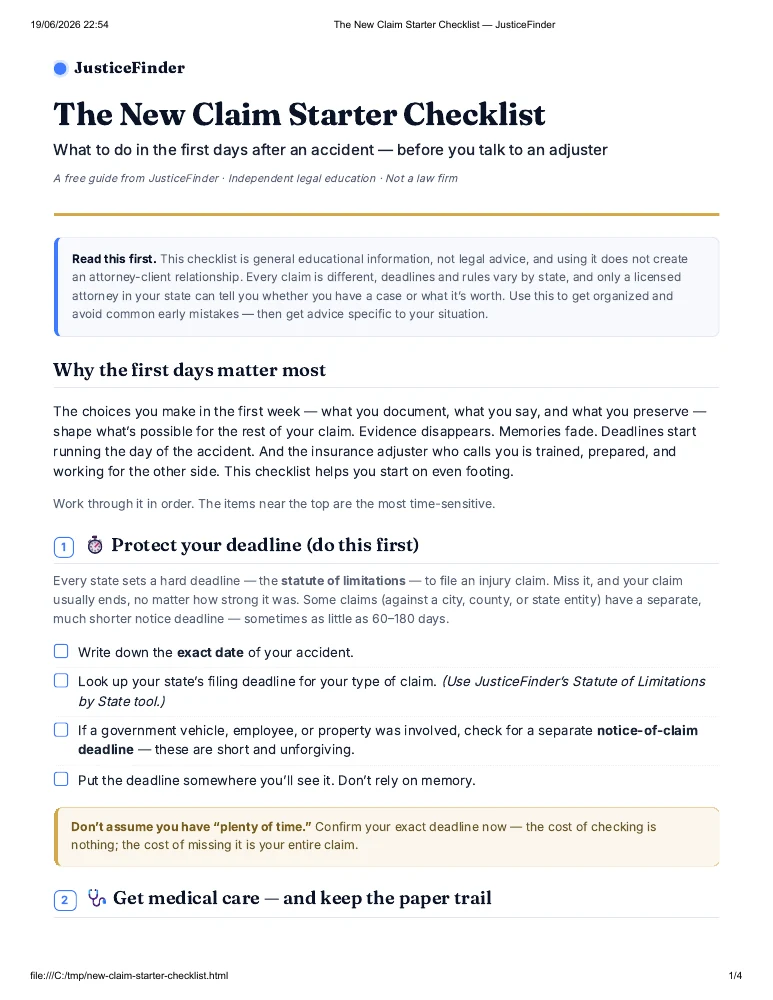
A calm, ordered list of the first moves that protect a claim: the deadline to confirm, the evidence to lock down today, the medical record to start, and what to have ready before a free attorney consult.

Cost

100% free

Format

PDF · keep

Delivery

Instant

What's Inside

10 sections — nothing generic

  1. 01Start Here: The Deadline You Can't Undo
  2. 02Confirm Your Statute of Limitations
  3. 03Evidence to Preserve in the First 72 Hours
  4. 04Scene, Photos, and Witness Checklist
  5. 05Documenting the Injury and Your Treatment
  6. 06Tracking Losses: Bills, Wages, and Out-of-Pocket
  7. 07What to Avoid Saying to an Adjuster
  8. 08Is This Worth a Lawyer? How to Decide
  9. 09What to Bring to a Free Consultation
  10. 10Your Next-Steps Worksheet

The Solution

Free first-steps checklist for the days right after an injury — before you talk to anyone.

Turns a confusing 'what do I even do first?' moment into an ordered checklist: confirm the deadline, preserve proof, document the injury, and prepare for a free consultation — without overstepping into a verdict on the case.

Deadline-first: how to confirm your statute of limitations before anything else can expire.

Evidence-preservation list for photos, scene details, witnesses, and records to lock down today.

Consultation-prep section so your first free attorney call is organized instead of improvised.

Source Anchors

This guide references official government sources, not opinion.

The Problem

Most claimants leave money on the table — not because they lack a case, but because they lack a system.

In the first days after an injury, claimants lose evidence, miss the deadline that quietly controls everything, and say things to adjusters they cannot take back — usually before they ever speak to a lawyer.

Built for:

Newly injured person deciding whether and how to pursue a claim.

Who This Is For

  • People in the first days or weeks after an accident who aren't sure if they have a case yet.
  • Claimants who want to protect evidence and the deadline before talking to an insurer.
  • Anyone preparing for a free attorney consultation who wants to walk in organized.

What You'll Learn

  • Why the filing deadline is the one element that can quietly expire — and how to confirm yours.
  • What evidence to preserve immediately and what can still be recovered after a few days.
  • How to document the injury and your losses so a consultation starts from a strong record.

Free Tools That Pair With This Guide

Frequently Asked Questions

What buyers ask before getting this guide

What is the very first thing I should do after an injury?

Confirm your deadline. Every personal-injury claim is governed by a statute of limitations, and it is the one element that can quietly expire while you focus on recovery. The checklist puts the deadline first, then walks through evidence, documentation, and consultation prep in order.

Does this checklist tell me whether I have a case?

No — and it is designed not to. Whether facts add up to a viable claim is a legal judgment only a licensed attorney can make. The checklist helps you protect the deadline, preserve evidence, and organize your record so a free consultation is far more productive.

What evidence should I preserve right away?

Scene photos, vehicle or hazard images, witness names and contact information, the police or incident report number, and anything physical tied to the injury. The checklist's first-72-hours section lists each category and notes what can still be recovered later if you missed it.

What should I avoid saying to an insurance adjuster?

Avoid guessing about fault, downplaying your injuries, or giving a recorded statement before you understand what is being asked. The checklist includes a short 'what to avoid saying' section so an early conversation doesn't undercut a claim you haven't even evaluated yet.

How do I document my injury for a claim?

Get medical attention promptly even if you feel okay, follow through on treatment, and keep a simple symptom log from day one. The checklist provides documentation prompts that build a consistent medical and losses trail an attorney can work from.

Do I need a lawyer to use this checklist?

No. The checklist is built for the stage before you've hired anyone — when you're still deciding. It helps you protect your position and prepare, and it includes a 'what to bring to a free consultation' section for when you're ready to talk to an attorney.

Is the New Claim Starter Checklist really free?

Yes. It is provided at no cost in exchange for your email. JusticeFinder uses it as an educational lead magnet. After you access it you may receive follow-up resources, but there is no obligation and you can unsubscribe at any time.

Who should download this checklist?

Anyone in the first days or weeks after an accident who is still asking 'do I have a case?' and wants to protect the deadline, evidence, and their own words before talking to an insurer or attorney. It pairs directly with the free 'Do I Have a Case?' Screener.

Free educational checklist only. It does not tell you whether you have a case, is not legal advice, and does not create an attorney-client relationship. Deadlines and rules vary by state — consult a licensed attorney promptly, especially if a deadline may be near.

Pairs well withBrowse all →
Related free reading

Continue Exploring

Keep moving through the claim process.

JusticeFinder is designed so every visit can turn into a concrete next step, whether that means opening a calculator, reading a guide, organizing records, or searching the library directly.

Read JusticeFinder elsewhere

TikTok, Instagram, and Threads — short-form legal explainers from the editorial team.